Happy 75th anniversary Rudolph

rudolf coverBalsam wreaths and visions of sugarplums had barely faded in the first weeks of 1939, but thoughts inside the Chicago headquarters of retail giant Montgomery Ward had already turned to the next Christmas 11 months away. The retailer had traditionally purchased and distributed coloring books to children as a holiday promotion, but the advertising department decided it would be cheaper and more effective instead to develop its own Christmas-themed book in-house.

The assignment fell to Robert May, a copywriter with a knack for turning a limerick at the company’s holiday party. The adman, however, had difficulty summoning up holiday cheer, and not just because of the date on the calendar. Not only was the United States still trying to shake the decade-long Great Depression while the rumblings of war grew once again Europe, but May’s wife was suffering with cancer and the medical bills had thrown the family into debt. Sure, he was pursuing his passion to write, but churning out mail order catalog copy about men’s shirts instead of penning the Great American Novel was not what he had envisioned himself doing at age 33 with a degree from Dartmouth College.

Given the assignment to develop an animal story, May thought a reindeer was a natural for the leading role (not to mention that his 4-year-old daughter, Barbara, loved the reindeer  every Rudolph creator Robert Maytime she visited the zoo). As he peered out at the thick fog that had drifted off Lake Michigan, May came up with the idea of a misfit reindeer ostracized because of his luminescent nose who used his physical abnormality to guide Santa’s sleigh and save Christmas. Seeking an alliterative name, May scribbled possibilities on a scrap of paper—Rollo, Reginald, Rodney and Romeo were among the choices—before circling his favorite. Rudolph.

As May worked on “Rudolph the Red-Nosed Reindeer” through the summer, his wife’s health worsened. She passed away in July 1939. Now a widower and a single father, May refused the offer of his boss to give the assignment to someone else. “I needed Rudolph now more than ever,” he later wrote. Burying his grief, May finished the story in August.

The 89 rhyming couplets in “Rudolph the Red-Nosed Reindeer” borrow from Clement Clarke Moore’s “A Visit from St. Nicholas” right from the story’s opening line: “Twas the day before Christmas, and all through the hills/The reindeer were playing…enjoying the spills.” Hans Christian Andersen’s fairy tale “The Ugly Duckling” also inspired the storyline as did May’s own childhood when he endured taunts from schoolmates for being small and shy. “Rudolph and I were something alike,” the copywriter told Guideposts magazine in January 1975. “As a child I’d always been the smallest in the class. Frail, poorly coordinated, I was never asked to join the school teams.”

In 1949, songwriter Johnny Marks, who happened to be May’s brother-in-law, set Rudolph’s story to music. After Bing Crosby reportedly turned down the chance, singing cowboy Gene Autry recorded the song, which sold 2 million copies in the first year and remains one of the best-selling tunes of all time.

Source: Rudolph the red nosed reindeer turns 75



Posted in Christmas | 1 Comment

Here Comes Santa Claus

santawithkids2014Sinter Klaas Comes To New York

St. Nicholas made his first inroads into American popular culture towards the end of the 18th century. In December 1773, and again in 1774, a New York newspaper reported that groups of Dutch families had gathered to honor the anniversary of his death.

The name Santa Claus evolved from Nick’s Dutch nickname, Sinter Klaas, a shortened form of Sint Nikolaas (Dutch for Saint Nicholas). In 1804, John Pintard, a member of the New York Historical Society, distributed woodcuts of St. Nicholas at the society’s annual meeting. The background of the engraving contains now-familiar Santa images including stockings filled with toys and fruit hung over a fireplace. In 1809, Washington Irving helped to popularize the Sinter Klaas stories when he referred to St. Nicholas as the patron saint of New York in his book, The History of New York. As his prominence grew, Sinter Klaas was described as everything from a “rascal” with a blue three-cornered hat, red waistcoat, and yellow stockings to a man wearing a broad-brimmed hat and a “huge pair of Flemish trunk hose.”

Gift-giving, mainly centered around children, has been an important part of the Christmas celebration since the holiday’s rejuvenation in the early 19th century. Stores began to advertise Christmas shopping in 1820, and by the 1840s, newspapers were creating separate sections for holiday advertisements, which often featured images of the newly-popular Santa Claus. In 1841, thousands of children visited a Philadelphia shop to see a life-size Santa Claus model. It was only a matter of time before stores began to attract children, and their parents, with the lure of a peek at a “live” Santa Claus. In the early 1890s, the Salvation Army needed money to pay for the free Christmas meals they provided to needy families. They began dressing up unemployed men in Santa Claus suits and sending them into the streets of New York to solicit donations. Those familiar Salvation Army Santas have been ringing bells on the street corners of American cities ever since.

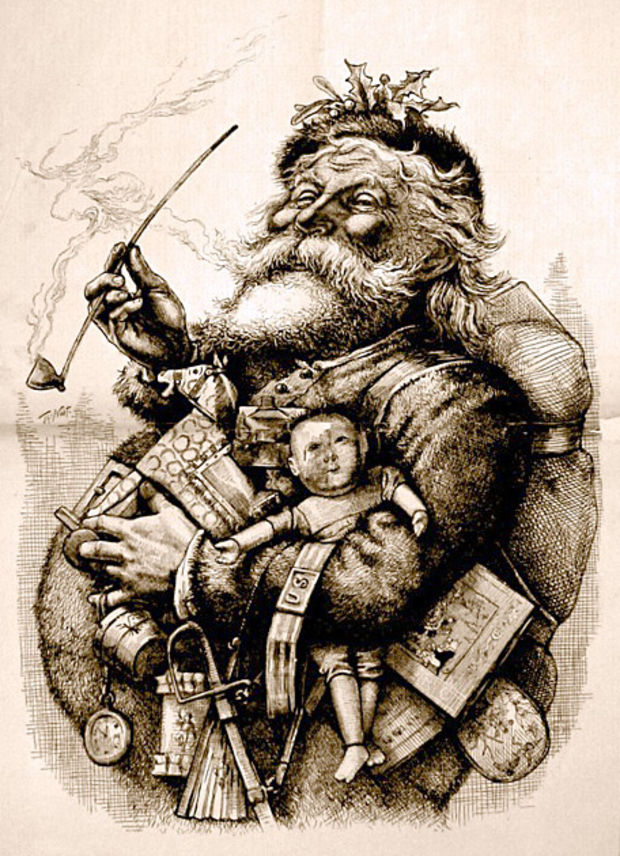
In 1822, Clement Clarke Moore, an Episcopal minister, wrote a long Christmas poem for his three daughters entitled “An Account of a Visit from St. Nicholas.” Moore’s poem, which he was initially hesitant to publish due to the frivolous nature of its subject, is largely responsible for our modern image of Santa Claus as a “right jolly old elf” with a portly figure and the supernatural ability to ascend a chimney with a mere nod of his head! Although some of Moore’s imagery was probably borrowed from other sources, his poem helped popularize the now-familiar image of a Santa Claus who flew from house to house on Christmas Eve–in “a miniature sleigh” led by eight flying reindeer–leaving presents for deserving children. “An Account of a Visit from St. Nicholas” created a new and immediately popular American icon. In 1881, political cartoonist Thomas Nast drew on Moore’s poem to create the first likeness that matches our modern image of Santa Claus. His cartoon, which appeared in Harper’s Weekly, depicted Santa as a rotund, cheerful man with a full, white beard, holding a sack laden with toys for lucky children. It is Nast who gave Santa his bright red suit trimmed with white fur, North Pole workshop, elves, and his wife, Mrs. Claus.

18th-century America’s Santa Claus was not the only St. Nicholas-inspired gift-giver to make an appearance at Christmastime. Similar figures were popular all over the world. Christkind or Kris Kringle was believed to deliver presents to well-behaved Swiss and German children. Meaning “Christ child,” Christkind is an angel-like figure often accompanied by St. Nicholas on his holiday missions. In Scandinavia, a jolly elf named Jultomten was thought to deliver gifts in a sleigh drawn by goats. English legend explains that Father Christmas visits each home on Christmas Eve to fill children’s stockings with holiday treats. Père Noël is responsible for filling the shoes of French children. In Russia, it is believed that an elderly woman named Babouschka purposely gave the wise men wrong directions to Bethlehem so that they couldn’t find Jesus. Later, she felt remorseful, but could not find the men to undo the damage. To this day, on January 5, Babouschka visits Russian children leaving gifts at their bedsides in the hope that one of them is the baby Jesus and she will be forgiven. In Italy, a similar story exists about a woman called La Befana, a kindly witch who rides a broomstick down the chimneys of Italian homes to deliver toys into the stockings of lucky children.

Source: Santa Claus – HISTORY.com

Posted in Christmas | Comments Off on Here Comes Santa Claus

Who is St. Nicholas?

mti2ndiyndiynzu1nzc1nzyySt. Nicholas was a Christian bishop who provided for the poor and sick, and is the basis for the popular character of Santa Claus.
Born in Patara, a land that is part of present-day Turkey, circa 280, St. Nicholas was a Christian bishop who helped the needy. After his death, the legend of his gift-giving grew. St. Nicholas transformed into the legendary character called Santa Claus, who brings Christmas presents to children around the world.
Early Life

St. Nicholas was born sometime circa 280 in Patara, Lycia, an area that is part of present-day Turkey. He lost both of his parents as a young man and reportedly used his inheritance to help the poor and sick. A devout Christian, he later served as bishop of Myra, a city that is now called Demre.

Reputation
There are many legends about St. Nicholas of Myra. One story tells how he helped three poor sisters. Their father did not have enough money to pay their dowries and thought of selling them into servitude. Three times, St. Nicholas secretly went to their house at night and put a bag of money inside. The man used the money so that one of his daughters could marry. On the third visit, the man saw St. Nicholas and thanked him for his kindness. He also reportedly saved three men who were falsely imprisoned and sentenced to death.  
Death and Legacy
Several sources state St. Nicholas is believed to have died on December 6, 343. Over the years, stories of his miracles and work for the poor spread to other parts of the world. He became known as the protector of children and sailors and was associated with gift-giving. He was a popular saint in Europe until the time of the Reformation in the 1500s, a religious movement that led to the creation of Protestantism, which turned away from the practice of honoring saints. St. Nicholas, however, remained an important figure in Holland.
 
The Dutch continued to celebrate the feast day of St. Nicholas, December 6. It was a common practice for children to put out their shoes the night before. In the morning, they would discover the gifts that St. Nicholas had left there for them.
 
So how did this Dutch tradition become the Santa Claus that we know and love today?  Check back tomorrow as we explore the history of Santa Claus.
Source: St. Nicholas – Saint – Biography.com
Posted in Christmas | 3 Comments