
Malachi 1:1-4:6 – The Day of Judgement 

07_Daniel_Dream_1024

The incidental music to Alphonse Daudet’s play L’Arlésienne (usually translated as ‘The Girl from Arles’) was composed by Georges Bizet for the first performance of the play on 1 October 1872 at the Vaudeville Theatre (now known as the Paramount Theatre).[1] It consists of 27 numbers (some only a few bars) for voice, chorus, and small orchestra, ranging from short solos to longer entr’actes. Bizet himself played the harmonium backstage at the premiere performance.

La música incidental para la obra de Alphonse Daudet L’Arlesienne (generalmente traducido como “La chica de Arles ‘) fue compuesta por Georges Bizet para la primera representación de la obra en 01 de octubre 1872 en el Vaudeville Theatre (ahora conocido como el Teatro Paramount). [1] Se compone de 27 números (unos pocos bares) para voz, coro y orquesta pequeña, que van de corto a largo solos entreactos. Mismo Bizet tocaba el armonio backstage en el estreno.

La musica di scena per un gioco da Alphonse Daudet L’Arlésienne (di solito tradotto come ‘The Girl da Arles’) è stata composta da Georges Bizet per la prima rappresentazione dello spettacolo il 1 ° ottobre 1872, il Teatro Vaudeville (ora conosciuto come il Teatro Paramount). [1] Si compone di 27 numeri (alcuni solo pochi bar) per voce, coro e piccola orchestra, che vanno da breve a soli siparietti più lunghi. Bizet si suonava il backstage armonium alla prima esecuzione.

Source: Malachi 1:1-4:6  Malaquías 1-4:6(Español)  Malachia 1-4:6(Italiano)

Malachi 1-4:6

A prophecy: The word of the Lord to Israel through Malachi.[a]

Israel Doubts God’s Love

“I have loved you,” says the Lord.

“But you ask, ‘How have you loved us?’

“Was not Esau Jacob’s brother?” declares the Lord. “Yet I have loved Jacob, but Esau I have hated, and I have turned his hill country into a wasteland and left his inheritance to the desert jackals.”

Edom may say, “Though we have been crushed, we will rebuild the ruins.”

But this is what the Lord Almighty says: “They may build, but I will demolish. They will be called the Wicked Land, a people always under the wrath of the Lord. You will see it with your own eyes and say, ‘Great is the Lord—even beyond the borders of Israel!’

Breaking Covenant Through Blemished Sacrifices

“A son honors his father, and a slave his master. If I am a father, where is the honor due me? If I am a master, where is the respect due me?” says the Lord Almighty.

“It is you priests who show contempt for my name.

“But you ask, ‘How have we shown contempt for your name?’

“By offering defiled food on my altar.

“But you ask, ‘How have we defiled you?’

“By saying that the Lord’s table is contemptible. When you offer blind animals for sacrifice, is that not wrong? When you sacrifice lame or diseased animals, is that not wrong? Try offering them to your governor! Would he be pleased with you? Would he accept you?” says the Lord Almighty.

“Now plead with God to be gracious to us. With such offerings from your hands, will he accept you?”—says the Lord Almighty.

10 “Oh, that one of you would shut the temple doors, so that you would not light useless fires on my altar! I am not pleased with you,” says the Lord Almighty, “and I will accept no offering from your hands. 11 My name will be great among the nations, from where the sun rises to where it sets. In every place incense and pure offerings will be brought to me, because my name will be great among the nations,” says the Lord Almighty.

12 “But you profane it by saying, ‘The Lord’s table is defiled,’ and, ‘Its food is contemptible.’ 13 And you say, ‘What a burden!’ and you sniff at it contemptuously,” says the Lord Almighty.

“When you bring injured, lame or diseased animals and offer them as sacrifices, should I accept them from your hands?” says the Lord. 14 “Cursed is the cheat who has an acceptable male in his flock and vows to give it, but then sacrifices a blemished animal to the Lord. For I am a great king,” says the Lord Almighty, “and my name is to be feared among the nations.

Additional Warning to the Priests

“And now, you priests, this warning is for you. If you do not listen, and if you do not resolve to honor my name,” says the Lord Almighty, “I will send a curse on you, and I will curse your blessings. Yes, I have already cursed them, because you have not resolved to honor me.

“Because of you I will rebuke your descendants[b]; I will smear on your faces the dung from your festival sacrifices, and you will be carried off with it. And you will know that I have sent you this warning so that my covenant with Levi may continue,” says the Lord Almighty. “My covenant was with him, a covenant of life and peace, and I gave them to him; this called for reverence and he revered me and stood in awe of my name. True instruction was in his mouth and nothing false was found on his lips. He walked with me in peace and uprightness, and turned many from sin.

“For the lips of a priest ought to preserve knowledge, because he is the messenger of the Lord Almighty and people seek instruction from his mouth. But you have turned from the way and by your teaching have caused many to stumble; you have violated the covenant with Levi,” says the Lord Almighty. “So I have caused you to be despised and humiliated before all the people, because you have not followed my ways but have shown partiality in matters of the law.”

Breaking Covenant Through Divorce

10 Do we not all have one Father[c]? Did not one God create us? Why do we profane the covenant of our ancestors by being unfaithful to one another?

11 Judah has been unfaithful. A detestable thing has been committed in Israel and in Jerusalem: Judah has desecrated the sanctuary the Lord loves by marrying women who worship a foreign god. 12 As for the man who does this, whoever he may be, may the Lord remove him from the tents of Jacob[d]—even though he brings an offering to the Lord Almighty.

13 Another thing you do: You flood the Lord’s altar with tears. You weep and wail because he no longer looks with favor on your offerings or accepts them with pleasure from your hands. 14 You ask, “Why?” It is because the Lordis the witness between you and the wife of your youth. You have been unfaithful to her, though she is your partner, the wife of your marriage covenant.

15 Has not the one God made you? You belong to him in body and spirit. And what does the one God seek? Godly offspring.[e] So be on your guard, and do not be unfaithful to the wife of your youth.

16 “The man who hates and divorces his wife,” says the Lord, the God of Israel, “does violence to the one he should protect,”[f] says the Lord Almighty.

So be on your guard, and do not be unfaithful.

Breaking Covenant Through Injustice

17 You have wearied the Lord with your words.

“How have we wearied him?” you ask.

By saying, “All who do evil are good in the eyes of the Lord, and he is pleased with them” or “Where is the God of justice?”

“I will send my messenger, who will prepare the way before me. Then suddenly the Lord you are seeking will come to his temple; the messenger of the covenant, whom you desire, will come,” says the Lord Almighty.

But who can endure the day of his coming? Who can stand when he appears? For he will be like a refiner’s fireor a launderer’s soap. He will sit as a refiner and purifier of silver; he will purify the Levites and refine them like gold and silver. Then the Lord will have men who will bring offerings in righteousness, and the offerings of Judah and Jerusalem will be acceptable to the Lord, as in days gone by, as in former years.

“So I will come to put you on trial. I will be quick to testify against sorcerers, adulterers and perjurers, against those who defraud laborers of their wages, who oppress the widows and the fatherless, and deprive the foreigners among you of justice, but do not fear me,” says the Lord Almighty.

Breaking Covenant by Withholding Tithes

“I the Lord do not change. So you, the descendants of Jacob, are not destroyed. Ever since the time of your ancestors you have turned away from my decrees and have not kept them. Return to me, and I will return to you,”says the Lord Almighty.

“But you ask, ‘How are we to return?’

“Will a mere mortal rob God? Yet you rob me.

“But you ask, ‘How are we robbing you?’

“In tithes and offerings. You are under a curse—your whole nation—because you are robbing me. 10 Bring the whole tithe into the storehouse, that there may be food in my house. Test me in this,” says the Lord Almighty, “and see if I will not throw open the floodgates of heaven and pour out so much blessing that there will not be room enough to store it. 11 I will prevent pests from devouring your crops, and the vines in your fields will not drop their fruit before it is ripe,” says the Lord Almighty. 12 “Then all the nations will call you blessed, for yours will be a delightful land,” says the Lord Almighty.

Israel Speaks Arrogantly Against God

13 “You have spoken arrogantly against me,” says the Lord.

“Yet you ask, ‘What have we said against you?’

14 “You have said, ‘It is futile to serve God. What do we gain by carrying out his requirements and going about like mourners before the Lord Almighty? 15 But now we call the arrogant blessed. Certainly evildoers prosper, and even when they put God to the test, they get away with it.’”

The Faithful Remnant

16 Then those who feared the Lord talked with each other, and the Lord listened and heard. A scroll of remembrance was written in his presence concerning those who feared the Lord and honored his name.

17 “On the day when I act,” says the Lord Almighty, “they will be my treasured possession. I will spare them, just as a father has compassion and spares his son who serves him. 18 And you will again see the distinction between the righteous and the wicked, between those who serve God and those who do not.

Judgment and Covenant Renewal

[g]“Surely the day is coming; it will burn like a furnace. All the arrogant and every evildoer will be stubble, and the day that is coming will set them on fire,” says the Lord Almighty. “Not a root or a branch will be left to them.But for you who revere my name, the sun of righteousness will rise with healing in its rays. And you will go out and frolic like well-fed calves. Then you will trample on the wicked; they will be ashes under the soles of your feet on the day when I act,” says the Lord Almighty.

“Remember the law of my servant Moses, the decrees and laws I gave him at Horeb for all Israel.

“See, I will send the prophet Elijah to you before that great and dreadful day of the Lord comes. He will turn the hearts of the parents to their children, and the hearts of the children to their parents; or else I will come and strikethe land with total destruction.”

Posted in Essential 100 | Comments Off on Malachi 1:1-4:6 – The Day of Judgement 

Jonah 1:1-4:11 – The Story of Jonah 

17_Jonah_Nineveh_JPEG_1024The Sea & Sinbad’s Ship is the first movement in Scheherazade, Op. 35, a symphonic poem composed by Nikolai Rimsky-Korsakov in 1888. Based on One Thousand and One Nights, sometimes known as The Arabian Nights,[1] this orchestral work combines two features typical of Russian music and of Rimsky-Korsakov in particular: dazzling, colorful orchestration and an interest in the East, which figured greatly in the history of Imperial Russia, as well as orientalism in general.

El Mar y Sinbad del barco es el primer movimiento de Scheherazade, Op. 35, un poema sinfónico compuesto por Nikolai Rimsky-Korsakov en 1888. Sobre la base de las Mil y una noches, a veces conocido como Las mil y una noches, [1] esta orquesta combina el trabajo dos características típicas de la música rusa y de Rimsky-Korsakov, en particular: deslumbrante, colorida orquestación y un interés en el este, que figuró en gran medida en la historia de la Rusia Imperial, así como el orientalismo en general.

Nave The Sea & Sinbad di è il primo movimento di Scheherazade, Op. 35, un poema sinfonico composto da Nikolaj Rimskij-Korsakov nel 1888. Sulla base di Le mille e una notte, a volte conosciuto come mille e una notte, [1] esta combinare lavoro orchestrale due caratteristiche tipiche della musica russa e di Rimsky-Korsakov in particolare: abbagliante, orchestrazione colorata e un interesse per l’Oriente, che ha notevolmente figurato nella storia della Russia imperiale, così come orientalismo in generale.

Source: Jonah 1:1-4:11  Jonás 1-4:11(Español)  Giona 1-4:11(Italiano)

Jonah 1-4:11

Jonah Flees From the Lord

The word of the Lord came to Jonah son of Amittai: “Go to the great city of Nineveh and preach against it, because its wickedness has come up before me.”

But Jonah ran away from the Lord and headed for Tarshish. He went down to Joppa, where he found a ship bound for that port. After paying the fare, he went aboard and sailed for Tarshish to flee from the Lord.

Then the Lord sent a great wind on the sea, and such a violent storm arose that the ship threatened to break up.All the sailors were afraid and each cried out to his own god. And they threw the cargo into the sea to lighten the ship.

But Jonah had gone below deck, where he lay down and fell into a deep sleep. The captain went to him and said, “How can you sleep? Get up and call on your god! Maybe he will take notice of us so that we will not perish.”

Then the sailors said to each other, “Come, let us cast lots to find out who is responsible for this calamity.” They cast lots and the lot fell on Jonah. So they asked him, “Tell us, who is responsible for making all this trouble for us? What kind of work do you do? Where do you come from? What is your country? From what people are you?”

He answered, “I am a Hebrew and I worship the Lord, the God of heaven, who made the sea and the dry land.”

10 This terrified them and they asked, “What have you done?” (They knew he was running away from the Lord, because he had already told them so.)

11 The sea was getting rougher and rougher. So they asked him, “What should we do to you to make the sea calm down for us?”

12 “Pick me up and throw me into the sea,” he replied, “and it will become calm. I know that it is my fault that this great storm has come upon you.”

13 Instead, the men did their best to row back to land. But they could not, for the sea grew even wilder than before. 14 Then they cried out to the Lord, “Please, Lord, do not let us die for taking this man’s life. Do not hold us accountable for killing an innocent man, for you, Lord, have done as you pleased.” 15 Then they took Jonah and threw him overboard, and the raging sea grew calm. 16 At this the men greatly feared the Lord, and they offered a sacrifice to the Lord and made vows to him.

Jonah’s Prayer

17 Now the Lord provided a huge fish to swallow Jonah, and Jonah was in the belly of the fish three days and three nights. [a]From inside the fish Jonah prayed to the Lord his God. He said:

“In my distress I called to the Lord,
    and he answered me.
From deep in the realm of the dead I called for help,
    and you listened to my cry.
You hurled me into the depths,
    into the very heart of the seas,
    and the currents swirled about me;
all your waves and breakers
    swept over me.
I said, ‘I have been banished
    from your sight;
yet I will look again
    toward your holy temple.’
The engulfing waters threatened me,[b]
    the deep surrounded me;
    seaweed was wrapped around my head.
To the roots of the mountains I sank down;
    the earth beneath barred me in forever.
But you, Lord my God,
    brought my life up from the pit.

“When my life was ebbing away,
    I remembered you, Lord,
and my prayer rose to you,
    to your holy temple.

“Those who cling to worthless idols
    turn away from God’s love for them.
But I, with shouts of grateful praise,
    will sacrifice to you.
What I have vowed I will make good.
    I will say, ‘Salvation comes from the Lord.’”

10 And the Lord commanded the fish, and it vomited Jonah onto dry land.

Jonah Goes to Nineveh

Then the word of the Lord came to Jonah a second time: “Go to the great city of Nineveh and proclaim to it the message I give you.”

Jonah obeyed the word of the Lord and went to Nineveh. Now Nineveh was a very large city; it took three days to go through it. Jonah began by going a day’s journey into the city, proclaiming, “Forty more days and Nineveh will be overthrown.” The Ninevites believed God. A fast was proclaimed, and all of them, from the greatest to the least, put on sackcloth.

When Jonah’s warning reached the king of Nineveh, he rose from his throne, took off his royal robes, covered himself with sackcloth and sat down in the dust. This is the proclamation he issued in Nineveh:

“By the decree of the king and his nobles:

Do not let people or animals, herds or flocks, taste anything; do not let them eat or drink. But let people and animals be covered with sackcloth. Let everyone call urgently on God. Let them give up their evil ways and their violence. Who knows? God may yet relent and with compassion turn from his fierce anger so that we will not perish.”

10 When God saw what they did and how they turned from their evil ways, he relented and did not bring on them the destruction he had threatened.

Jonah’s Anger at the Lord’s Compassion

But to Jonah this seemed very wrong, and he became angry. He prayed to the Lord, “Isn’t this what I said, Lord, when I was still at home? That is what I tried to forestall by fleeing to Tarshish. I knew that you are a gracious and compassionate God, slow to anger and abounding in love, a God who relents from sending calamity. Now, Lord, take away my life, for it is better for me to die than to live.”

But the Lord replied, “Is it right for you to be angry?”

Jonah had gone out and sat down at a place east of the city. There he made himself a shelter, sat in its shade and waited to see what would happen to the city. Then the Lord God provided a leafy plant[c] and made it grow up over Jonah to give shade for his head to ease his discomfort, and Jonah was very happy about the plant. But at dawn the next day God provided a worm, which chewed the plant so that it withered. When the sun rose, God provided a scorching east wind, and the sun blazed on Jonah’s head so that he grew faint. He wanted to die, and said, “It would be better for me to die than to live.”

But God said to Jonah, “Is it right for you to be angry about the plant?”

“It is,” he said. “And I’m so angry I wish I were dead.”

10 But the Lord said, “You have been concerned about this plant, though you did not tend it or make it grow. It sprang up overnight and died overnight. 11 And should I not have concern for the great city of Nineveh, in which there are more than a hundred and twenty thousand people who cannot tell their right hand from their left—and also many animals?”

Posted in Essential 100 | 2 Comments

Daniel 6:1-28 – Daniel in the Lion’s Den 


13_Daniel_Lions_1024

The Carnival of the Animals (Le carnaval des animaux) is a musical suite of fourteen movements by the French Romantic composer Camille Saint-Saëns. The work was written for private performance by an ad hoc ensemble of two pianos and other instruments, and lasts around 25 minutes.

El Carnaval de los Animales (Le carnaval des animaux) es una suite musical de catorce movimientos por el compositor romántico francés Camille Saint-Saëns. La obra fue escrita para un rendimiento privado por un conjunto especial de dos pianos y otros instrumentos, y dura unos 25 minutos.

Il carnevale degli animali (Le Carnevale degli Animali) è una suite musicale di famose opere del compositore francese Camille Saint-Saëns. Il lavoro è stato scritto per la prestazione privata ad hoc insieme di due pianoforti ed altri strumenti, e dura circa 25 minuti.

Source: Daniel 6:1-28  Daniel 6:1-28(Español)  Daniele 6:1-28(Italiano)

Daniel 6:1-28

Daniel in the Den of Lions

[a]It pleased Darius to appoint 120 satraps to rule throughout the kingdom, with three administrators over them, one of whom was Daniel. The satraps were made accountable to them so that the king might not suffer loss. Now Daniel so distinguished himself among the administrators and the satraps by his exceptional qualities that the king planned to set him over the whole kingdom. At this, the administrators and the satraps tried to find grounds for charges against Daniel in his conduct of government affairs, but they were unable to do so. They could find no corruption in him, because he was trustworthy and neither corrupt nor negligent. Finally these men said, “We will never find any basis for charges against this man Daniel unless it has something to do with the law of his God.”

So these administrators and satraps went as a group to the king and said: “May King Darius live forever! The royal administrators, prefects, satraps, advisers and governors have all agreed that the king should issue an edict and enforce the decree that anyone who prays to any god or human being during the next thirty days, except to you, Your Majesty, shall be thrown into the lions’ den. Now, Your Majesty, issue the decree and put it in writing so that it cannot be altered—in accordance with the law of the Medes and Persians, which cannot be repealed.”So King Darius put the decree in writing.

10 Now when Daniel learned that the decree had been published, he went home to his upstairs room where the windows opened toward Jerusalem. Three times a day he got down on his knees and prayed, giving thanks to his God, just as he had done before. 11 Then these men went as a group and found Daniel praying and asking God for help. 12 So they went to the king and spoke to him about his royal decree: “Did you not publish a decree that during the next thirty days anyone who prays to any god or human being except to you, Your Majesty, would be thrown into the lions’ den?”

The king answered, “The decree stands—in accordance with the law of the Medes and Persians, which cannot be repealed.”

13 Then they said to the king, “Daniel, who is one of the exiles from Judah, pays no attention to you, Your Majesty, or to the decree you put in writing. He still prays three times a day.” 14 When the king heard this, he was greatly distressed; he was determined to rescue Daniel and made every effort until sundown to save him.

15 Then the men went as a group to King Darius and said to him, “Remember, Your Majesty, that according to the law of the Medes and Persians no decree or edict that the king issues can be changed.”

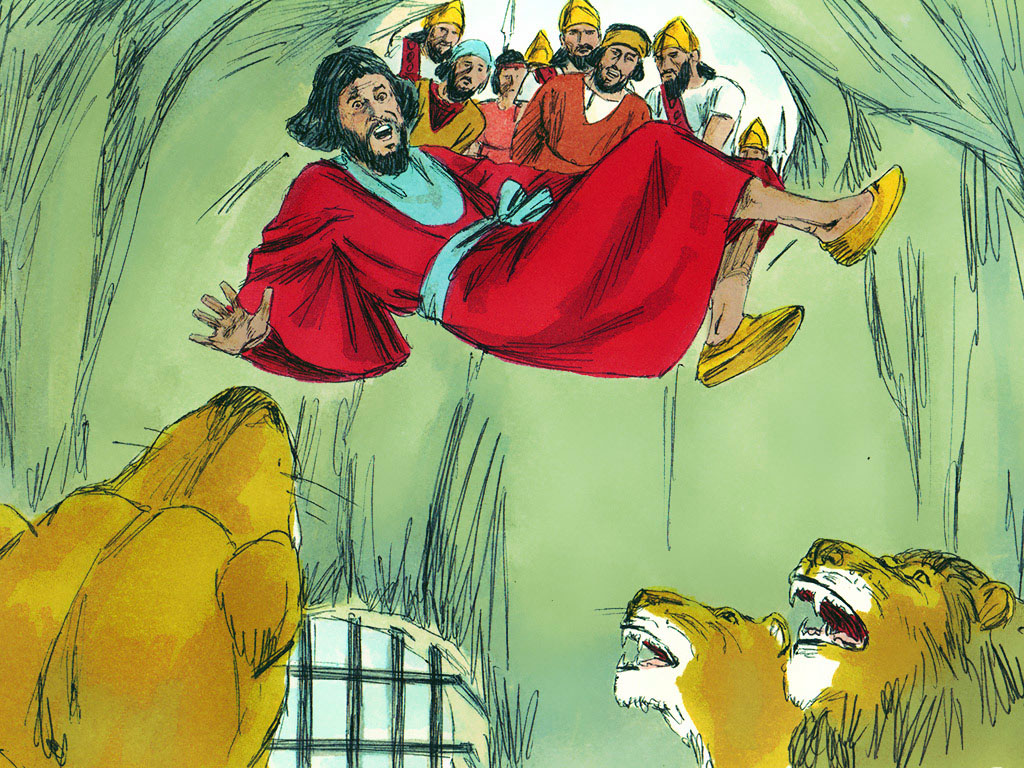
16 So the king gave the order, and they brought Daniel and threw him into the lions’ den. The king said to Daniel, “May your God, whom you serve continually, rescue you!”

17 A stone was brought and placed over the mouth of the den, and the king sealed it with his own signet ring and with the rings of his nobles, so that Daniel’s situation might not be changed. 18 Then the king returned to his palace and spent the night without eating and without any entertainment being brought to him. And he could not sleep.

19 At the first light of dawn, the king got up and hurried to the lions’ den. 20 When he came near the den, he called to Daniel in an anguished voice, “Daniel, servant of the living God, has your God, whom you serve continually, been able to rescue you from the lions?”

21 Daniel answered, “May the king live forever! 22 My God sent his angel, and he shut the mouths of the lions.They have not hurt me, because I was found innocent in his sight. Nor have I ever done any wrong before you, Your Majesty.”

23 The king was overjoyed and gave orders to lift Daniel out of the den. And when Daniel was lifted from the den, no wound was found on him, because he had trusted in his God.

24 At the king’s command, the men who had falsely accused Daniel were brought in and thrown into the lions’ den, along with their wives and children. And before they reached the floor of the den, the lions overpowered them and crushed all their bones.

25 Then King Darius wrote to all the nations and peoples of every language in all the earth:

“May you prosper greatly!

26 “I issue a decree that in every part of my kingdom people must fear and reverence the God of Daniel.

“For he is the living God
    and he endures forever;
his kingdom will not be destroyed,
    his dominion will never end.
27 He rescues and he saves;
    he performs signs and wonders
    in the heavens and on the earth.
He has rescued Daniel
    from the power of the lions.”

28 So Daniel prospered during the reign of Darius and the reign of Cyrus[b] the Persian.

Posted in Essential 100 | Comments Off on Daniel 6:1-28 – Daniel in the Lion’s Den