While Handel’s Messiah rightly holds its place as this country’s classical musical soundtrack for the holiday season (quibble if you will about its Easter message; there’s nothing wrong
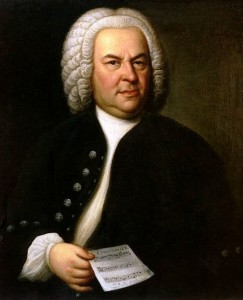
with talking about Easter at Christmas – just ask Bach!), it’s J.S. Bach’s Christmas Oratorio that rings through concert halls throughout Europe at this time of the year.
The Christmas Oratorio, is an oratorio by Johann Sebastian Bach intended for performance in church during the Christmas season. It was written for the Christmas season of 1734.
The oratorio is in six parts, each part being intended for performance on one of the major feast days of the Christmas period. The first part (for Christmas Day) describes the Birth of Jesus, the second (for December 26) the annunciation to the shepherds, the third (for December 27) the adoration of the shepherds, the fourth (for New Year’s Day) the circumcision and naming of Jesus, the fifth (for the first Sunday after New Year) the journey of the Magi, and the sixth (for Epiphany) the adoration of the Magi.
Share List
Posted inChristmas, General|Comments Off on Baroque Christmas Music
As traditional and familiar as most any English Christmas carol, the song is among the season’s more anachronistic, an evocation of a holiday custom that pretty much puzzles modern celebrants: wassailing.
Wassailing? What’s wassailing?
The text of the carol employs noun and verb forms of “wassail,” a word derived from the Old Norse ves heil and the Old English was hál and meaning “be in good health” or “be fortunate.” The phrase found first use as a simple greeting, but the Danish-speaking inhabitants of England seem to have turned was hail, and the reply drink hail, into a drinking formula adopted widely by the indigenous population of England.
Wassail also denoted the drink used for the toast. Rowena’s—Renwein in English—spiced wine resembled the ancient Roman hypocras, which survived into the early Middle Ages as a libation for the wealthy. The necessity of importing the wine and such spices as ginger, cinnamon, cloves, allspice, and nutmeg from outside England made it dear. When fine ales replaced the wine, more people could afford it, and recipes varied according to the means of each family. Though usually prepared for immediate consumption, wassail sometimes was bottled and allowed to ferment.
The term has evolved in English for more than a millennium, from its origins as a simple greeting, to its use as a toast in ritualized drinking, to its absorption into holiday customs rooted in notions of social propriety.
The first mention of a wassail bowl was in the thirteenth century, a vessel in which revelers dipped cakes and fine bread. The practice of floating crisps of bread in the wassail bowl gave rise to our use of “toast” as a drinking salutation.
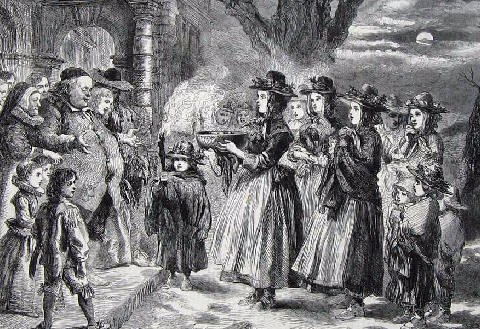
Friends—and strangers, too, as was sometimes custom—caroled their townsfolk on Christmas and were thanked with a glass of wassail. By about 1600, the practice of taking a wassail bowl about the streets had taken root. Instead of consuming the punch-like concoction at home, wassailers went house to house offering a warm drink, sometimes expecting payment.
It didn’t take long for wassailing in expectation of recompense to merge with other manifestations of holiday “misrule” that characterized old English Christmas. At Christmastide, the poor expected privileges denied them at other times, including the right to enter the homes of the wealthy, who feasted them from the best of their provisions. In exchange, the lord of the manor had the goodwill of his people for another year. At these gatherings, the bands of roving wassailers often performed songs for the master while drinking his beer, toasting him, his family, his livestock, wishing continued health and wealth.
The following holiday traditions are a direct result of the tradition of wassailing:
So lift your cups and join me now is I say was hál to this strange and wonderful old English tradition. And you thought wassailing was just a fancy name for caroling.
When Oliver Cromwell and the Puritans came to power in England in 1647, the celebration of Christmas and singing carols was stopped. However, the carols survived as people still sang them in secret. Carols remained mainly unsung until Victorian times, when two men called William Sandys and Davis Gilbert collected lots of old Christmas music from villages in England.
Before carol singing in public became popular, there were sometimes official carol singers called ‘Waits‘. These were bands of people led by important local leaders (such as council leaders) who had the only power in the towns and villages to take money from the public (if others did this, they were sometimes charged as beggars!). They were called ‘Waits’ because they only sang on Christmas Eve (This was sometimes known as ‘watchnight’ or ‘waitnight’ because of the shepherds were watching their sheep when the angels appeared to them.), when the Christmas celebrations began.
Also, at this time, many orchestras and choirs were being set up in the cities of England and people wanted Christmas songs to sing, so carols once again became popular. Many new carols, such as ‘Good King Wenceslas’, were also written in the Victorian period.
“Good King Wenceslas” is a popular Christmas carol that tells a story of a king braving harsh winter weather to give alms to a poor peasant on the Feast of Stephan (December 26, the day after Christmas). (Wikipedia)
New carols services were created and became popular, as did the custom of singing carols in the streets. Both of these customs are still popular today! One of the most popular types of Carols services are Carols by Candlelight services. At this service, the church is only lit by candlelight and it feels very Christmassy! Carols by Candlelight services are held in countries all over the world.