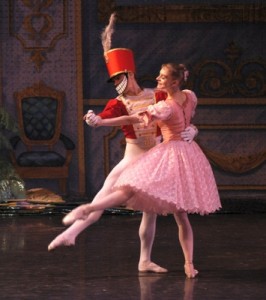
Christmas Carols on the Ballet Stage


The Nutcnutcrackerracker is a two-act ballet, originally choreographed by Marius Petipa and Lev Ivanov with a score by Pyotr Ilyich Tchaikovsky (op. 71). The libretto is adapted from E.T.A. Hoffmann’s story “The Nutcracker and the Mouse King.” It was given its première at the Mariinsky Theatre in St. Petersburg on Sunday, December 18, 1892, on a double-bill with Tchaikovsky’s opera, Iolanta.

Although the original production was not a success, the twenty-minute suite that Tchaikovsky extracted from the ballet was. However, the complete Nutcracker has enjoyed enormous popularity since the late 1960s and is now performed by countless ballet companies, primarily during the Christmas season, especially in the U.S. Major American ballet companies generate around 40 percent of their annual ticket revenues from performances of The Nutcracker.

via The Nutcracker – Wikipedia, the free encyclopedia.

Those of you with daughters are probably intimately familiar with this piece, as am I. Maybe it even brings back fond memories of your days as a ballerina.
 

Posted in Christmas | 1 Comment

Beethoven’s Christmas Contribution


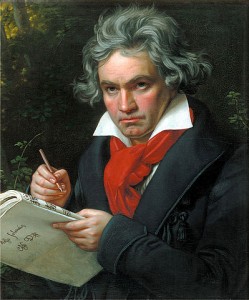
399px-Beethoven

“Ode To Joy” is the final movement of Beethoven’s Ninth and last Symphony. The German composer was increasingly aware of his declining health and spent seven years working on this symphony, starting the work in 1818 and finishing early in 1824. The symphony is one of the best known works of the Western classical repertoire and is considered one of Beethoven’s masterpieces.

At the time it was a novel idea to use a chorus and solo voices in a symphony, which is why it’s also called the “Choral” symphony. Beethoven, in fact, had serious misgivings about portraying the music’s message with actual words. Even after the premiere, he apparently came very close to replacing all the vocal lines with instrumental ones.

The words, which are sung by four vocal soloists and a chorus, emanate a strong belief in mankind. They were taken from a poem written by German writer Friedrich Schiller in 1785 and revised in 1803, with additions made by Beethoven.

Beethoven was completely deaf when he embarked on this masterpiece, and it’s a tragedy that he never heard a single note of it, except inside his head. At the end of the symphony’s first performance, the German composer, who had been directing the piece and was consequently facing the orchestra, had to be turned around by the contralto Caroline Unger so that he could see the audience’s ecstatic reaction. Beethoven had been unaware of the tumultuous roars of applause behind him.

via Ode To Joy by Ludwig Van Beethoven Songfacts.

I think Joy is a pretty good word to describe the people in this video.

Posted in Christmas | 1 Comment

Baroque Christmas Music

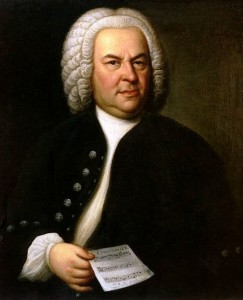
Johann_Sebastian_BachWhile Handel’s “Messiah” rightly holds its place as this country’s classical musical soundtrack for the holiday season (quibble if you will about its Easter message;  there’s nothing wrong
with talking about Easter at Christmas – just ask Bach!), it’s J.S. Bach’s “Christmas Oratorio” that rings through concert halls throughout Europe at this time of the year.

The Christmas Oratorio, is an oratorio by Johann Sebastian Bach intended for performance in church during the Christmas season. It was written for the Christmas season of 1734.

The oratorio is in six parts, each part being intended for performance on one of the major feast days of the Christmas period. The first part (for Christmas Day) describes the birth of Jesus, the second (for December 26) the annunciation to the shepherds, the third (for December 27) the adoration of the shepherds, the fourth (for New Year’s Day) the circumcision and naming of Jesus, the fifth (for the first Sunday after New Year) the journey of the Magi, and the sixth (for Epiphany) the adoration of the Magi.

Posted in Christmas | 1 Comment