Happy Mother’s Day to all the moms out there. We honor you today, the second Sunday in May because of all you have done for us. Today I want to share a few tidbits of information about this 110-year-old holiday.
Mother’s Day recognizes mothers, motherhood and maternal bonds in general, as well as the positive contributions that they make to society.
Establishment of Mother’s Day Holiday
The modern holiday of Mother’s Day was first celebrated in 1908. Anna Jarvis held a memorial for her mother at St Andrew’s Methodist Church in Grafton, West Virginia. St Andrew’s Methodist Church now holds the International Mother’s Day Shrine.
She campaigned to make Mother’s Day a recognized holiday in the United States beginning in 1905. Ann Reeves Jarvis, her mother, died that year. Ann Jarvis had been a peace activist who cared for wounded soldiers on both sides of the American Civil War. She created Mother’s Day Work Clubs to address public health issues. Anna Jarvis wanted to honor her mother by continuing the work she started. Additionally she wanted to set aside a day to honor all mothers because she believed a mother is “the person who has done more for you than anyone in the world”.
Protests and Carnations
Although Jarvis was successful in founding the holiday, she became resentful of the commercialization of the holiday. By the early 1920s, Hallmark Cards and other companies had started selling Mother’s Day cards. Jarvis believed that the companies had misinterpreted and exploited the idea of the day. Also she felt the emphasis of the holiday was on sentiment, not profit. As a result, she organized boycotts of Mother’s Day, and threatened to issue lawsuits against the companies involved.
Jarvis argued that people should appreciate and honor their mothers through handwritten letters expressing their love and gratitude. She thought people should do this instead of buying gifts and pre-made cards. She protested at a candy makers’ convention in Philadelphia in 1923. Also she demonstrated at a meeting of American War Mothers in 1925. By this time, sons and daughters were sending carnations as gifts on this day. Additionally authorities arrested Jarvis for disturbing the peace when she protested AWM’s carnation selling to raise money.
Sundays With Mom
Families all have traditions and routines. Ours was no different. Each Sunday mom began the day by dressing each of us in suits with clip-on bowties. But these were not ordinary suits. She purchased these suits at Freeman’s clothing store and they required alterations by tailors. We went to Sunday school and then sat through church. Dad gave us pencils so we could doodle during the service.
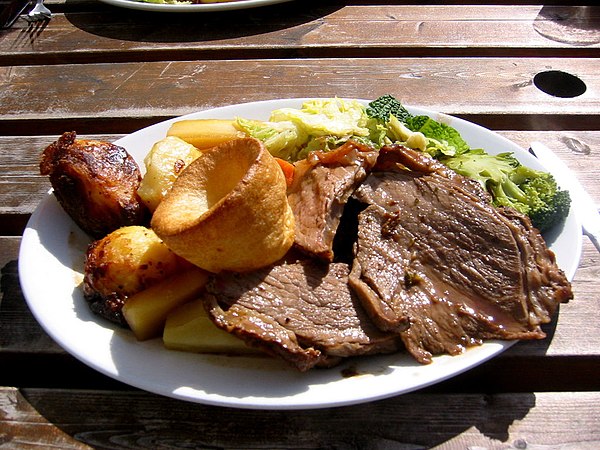
Mom prepared Sunday Roast each week. This traditional British main meal is typically served on Sunday (hence the name). It consists
of roasted meat, roast potato, vegetables like broccoli, carrots and onions, and gravy. She put the ingredients in a roasting pan and put it in the oven before we left for church.
Eventually she tired of preparing Sunday roast and our after church lunch became a visit to the heritage cafeteria.
Walk to the Paradise Garden is a composition by Delius. Frederick Theodore Albert Delius, CH (/ˈdiːlɪəs/[1] 29 January 1862 – 10 June 1934) was an English composer. Born in the north of England to a prosperous mercantile family, he resisted attempts to recruit him to commerce. He was sent to Florida in the United States in 1884 to manage an orange plantation.
Caminar hasta el Jardín Paraíso es una composición de Delius . Frederick Delius Theodore Albert , CH ( / diːlɪəs / [ 1 ] 29 enero 1862 a 10 junio 1934 ) fue un compositor Inglés . Nacido en el norte de Inglaterra a una familia mercantil próspera , se resistió a los intentos de reclutar al comercio . Fue enviado a la Florida en los Estados Unidos en 1884 para gestionar una plantación de naranja.
43 Now the famine was still severe in the land.2 So when they had eaten all the grain they had brought from Egypt, their father said to them, “Go back and buy us a little more food.”
3 But Judah said to him, “The man warned us solemnly, ‘You will not see my face again unless your brother is with you.’4 If you will send our brother along with us, we will go down and buy food for you.5 But if you will not send him, we will not go down, because the man said to us, ‘You will not see my face again unless your brother is with you.’”
6 Israel asked, “Why did you bring this trouble on me by telling the man you had another brother?”
7 They replied, “The man questioned us closely about ourselves and our family. ‘Is your father still living?’ he asked us. ‘Do you have another brother?’ We simply answered his questions. How were we to know he would say, ‘Bring your brother down here’?”
8 Then Judah said to Israel his father, “Send the boy along with me and we will go at once, so that we and you and our children may live and not die.9 I myself will guarantee his safety; you can hold me personally responsible for him. If I do not bring him back to you and set him here before you, I will bear the blame before you all my life.10 As it is, if we had not delayed, we could have gone and returned twice.”
11 Then their father Israel said to them, “If it must be, then do this: Put some of the best products of the land in your bags and take them down to the man as a gift—a little balm and a little honey, some spices and myrrh, some pistachio nuts and almonds.12 Take double the amount of silver with you, for you must return the silver that was put back into the mouths of your sacks. Perhaps it was a mistake.13 Take your brother also and go back to the man at once.14 And may God Almighty[a] grant you mercy before the man so that he will let your other brother and Benjamin come back with you. As for me, if I am bereaved, I am bereaved.”
15 So the men took the gifts and double the amount of silver, and Benjamin also. They hurried down to Egypt and presented themselves to Joseph.16 When Joseph saw Benjamin with them, he said to the steward of his house, “Take these men to my house, slaughter an animal and prepare a meal; they are to eat with me at noon.”
17 The man did as Joseph told him and took the men to Joseph’s house.18 Now the men were frightened when they were taken to his house. They thought, “We were brought here because of the silver that was put back into our sacks the first time. He wants to attack us and overpower us and seize us as slaves and take our donkeys.”
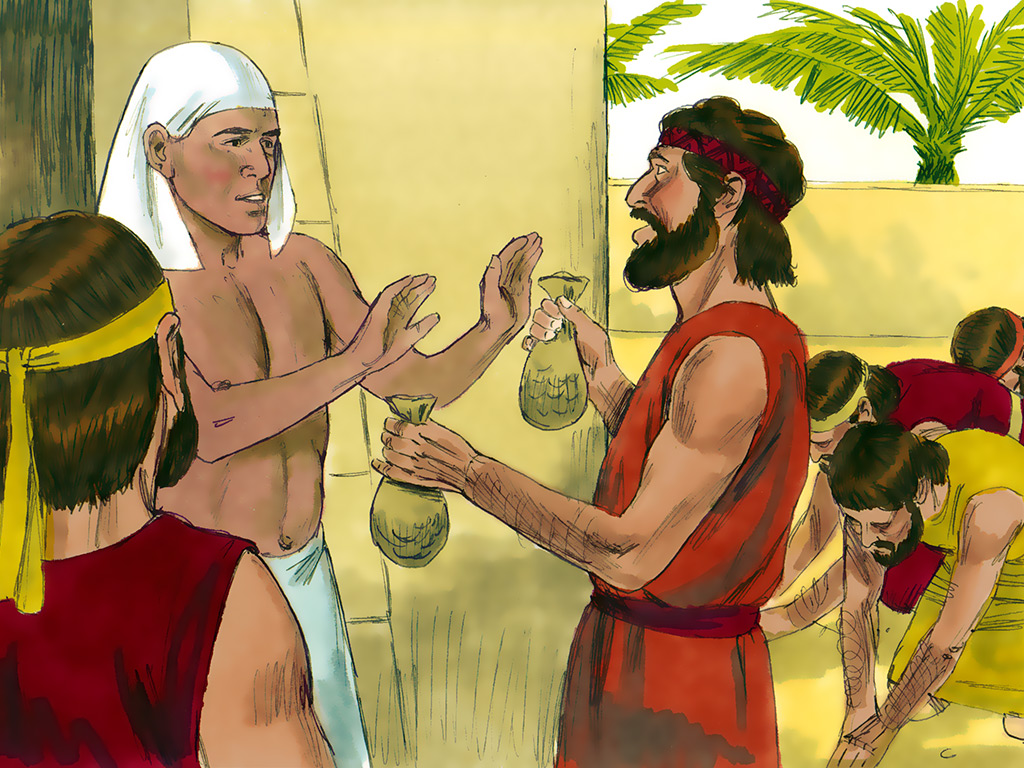
19 So they went up to Joseph’s steward and spoke to him at the entrance to the house.20 “We beg your pardon, our lord,” they said, “we came down here the first time to buy food.21 But at the place where we stopped for the night we opened our sacks and each of us found his silver—the exact weight—in the mouth of his sack. So we have brought it back with us.22 We have also brought additional silver with us to buy food. We don’t know who put our silver in our sacks.”
23 “It’s all right,” he said. “Don’t be afraid. Your God, the God of your father, has given you treasure in your sacks; I received your silver.” Then he brought Simeon out to them.
24 The steward took the men into Joseph’s house, gave them water to wash their feet and provided fodder for their donkeys.25 They prepared their gifts for Joseph’s arrival at noon, because they had heard that they were to eat there.
26 When Joseph came home, they presented to him the gifts they had brought into the house, and they bowed down before him to the ground.27 He asked them how they were, and then he said, “How is your aged father you told me about? Is he still living?”
28 They replied, “Your servant our father is still alive and well.” And they bowed down, prostrating themselves before him.
29 As he looked about and saw his brother Benjamin, his own mother’s son, he asked, “Is this your youngest brother, the one you told me about?” And he said, “God be gracious to you, my son.”30 Deeply moved at the sight of his brother, Joseph hurried out and looked for a place to weep. He went into his private room and wept there.
31 After he had washed his face, he came out and, controlling himself, said, “Serve the food.”
32 They served him by himself, the brothers by themselves, and the Egyptians who ate with him by themselves, because Egyptians could not eat with Hebrews, for that is detestable to Egyptians.33 The men had been seated before him in the order of their ages, from the firstborn to the youngest; and they looked at each other in astonishment.34 When portions were served to them from Joseph’s table, Benjamin’s portion was five times as much as anyone else’s. So they feasted and drank freely with him.
Genesis 44
A Silver Cup in a Sack
44 Now Joseph gave these instructions to the steward of his house: “Fill the men’s sacks with as much food as they can carry, and put each man’s silver in the mouth of his sack.2 Then put my cup, the silver one, in the mouth of the youngest one’s sack, along with the silver for his grain.” And he did as Joseph said.
3 As morning dawned, the men were sent on their way with their donkeys.4 They had not gone far from the city when Joseph said to his steward, “Go after those men at once, and when you catch up with them, say to them, ‘Why have you repaid good with evil?5 Isn’t this the cup my master drinks from and also uses for divination? This is a wicked thing you have done.’”
6 When he caught up with them, he repeated these words to them.7 But they said to him, “Why does my lord say such things? Far be it from your servants to do anything like that!8 We even brought back to you from the land of Canaan the silver we found inside the mouths of our sacks. So why would we steal silver or gold from your master’s house?9 If any of your servantsis found to have it, he will die; and the rest of us will become my lord’s slaves.”
10 “Very well, then,” he said, “let it be as you say. Whoever is found to have it will become my slave; the rest of you will be free from blame.”
11 Each of them quickly lowered his sack to the ground and opened it.12 Then the steward proceeded to search, beginning with the oldest and ending with the youngest. And the cup was found in Benjamin’s sack.13 At this, they tore their clothes.Then they all loaded their donkeys and returned to the city.
14 Joseph was still in the house when Judah and his brothers came in, and they threw themselves to the ground before him.15 Joseph said to them, “What is this you have done? Don’t you know that a man like me can find things out by divination?”
16 “What can we say to my lord?” Judah replied. “What can we say? How can we prove our innocence? God has uncovered your servants’ guilt. We are now my lord’s slaves—we ourselves and the one who was found to have the cup.”
17 But Joseph said, “Far be it from me to do such a thing! Only the man who was found to have the cup will become my slave.The rest of you, go back to your father in peace.”
18 Then Judah went up to him and said: “Pardon your servant, my lord, let me speak a word to my lord. Do not be angry with your servant, though you are equal to Pharaoh himself.19 My lord asked his servants, ‘Do you have a father or a brother?’20 And we answered, ‘We have an aged father, and there is a young son born to him in his old age. His brother is dead, and he is the only one of his mother’s sons left, and his father loves him.’
21 “Then you said to your servants, ‘Bring him down to me so I can see him for myself.’22 And we said to my lord, ‘The boy cannot leave his father; if he leaves him, his father will die.’23 But you told your servants, ‘Unless your youngest brother comes down with you, you will not see my face again.’24 When we went back to your servant my father, we told him what my lord had said.
25 “Then our father said, ‘Go back and buy a little more food.’26 But we said, ‘We cannot go down. Only if our youngest brother is with us will we go. We cannot see the man’s face unless our youngest brother is with us.’
27 “Your servant my father said to us, ‘You know that my wife bore me two sons.28 One of them went away from me, and I said, “He has surely been torn to pieces.” And I have not seen him since.29 If you take this one from me too and harm comes to him, you will bring my gray head down to the grave in misery.’
30 “So now, if the boy is not with us when I go back to your servant my father, and if my father, whose life is closely bound up with the boy’s life,31 sees that the boy isn’t there, he will die. Your servants will bring the gray head of our father down to the grave in sorrow.32 Your servant guaranteed the boy’s safety to my father. I said, ‘If I do not bring him back to you, I will bear the blame before you, my father, all my life!’
33 “Now then, please let your servant remain here as my lord’s slave in place of the boy, and let the boy return with his brothers.34 How can I go back to my father if the boy is not with me? No! Do not let me see the misery that would come on my father.”
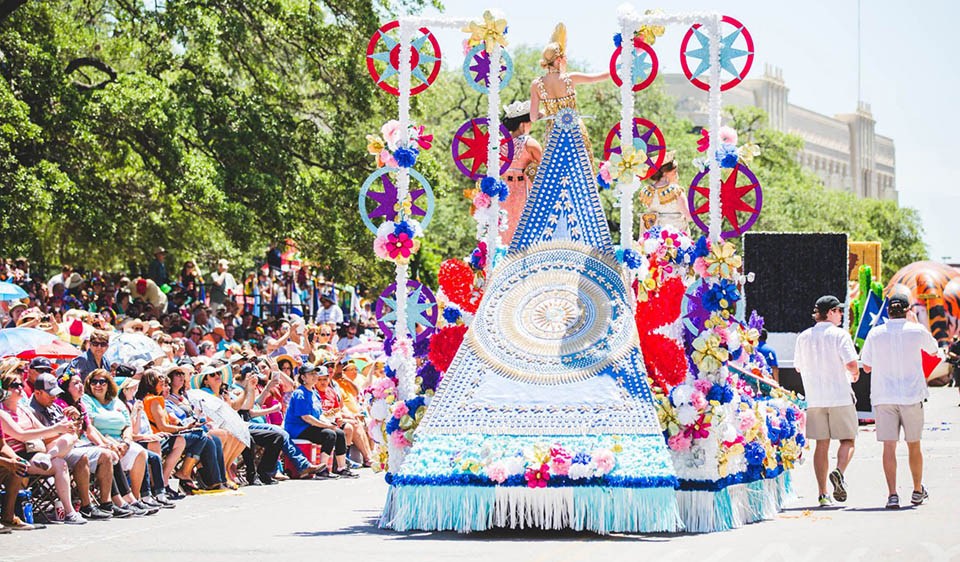
Every April, downtown San Antonio becomes the site of a citywide celebration – the Battle of Flowers Parade.
The Battle of Flowers Parade honors the heroic spirit of the patriots of the Alamo. It commemorates the victory of San Jacinto and celebrates the diversity and heritage of Texas and our nation. The parade also holds the distinction of being the first celebration to be held in Alamo Plaza. Also, it is considered the founding event of Fiesta San Antonio
Each year the Fiesta San Antonio Commission stages “Fiesta San Antonio” (or simply “Fiesta”). San Antonio holds this festival, the city’s signature event in April. The city began this festival in the late 19th century. Fiesta honors the memory of the battles of the Alamo and San Jacinto.
Battle of Flowers Parade beginnings
In 1891, local women decorated carriages, baby buggies and bicycles with live flowers. They then met in front of the Alamo and threw the blossoms at one another, thus inspiring the name “Battle of Flowers.” They soon added other activities to the flower parade. The city included balls, parties and a carnival. The celebration’s name changed over the years. Carnival became Spring Carnival then Fiesta San Jacinto. Finally, in 1960, the Commission changed the festival’s name to Fiesta San Antonio.
The Battle of Flowers parade supports the educational, artistic, social and philanthropic achievements of our community’s youth. Also, it is the second largest day parade in the U.S.. The parade has
entertained our city every year since 1891, except during World Wars I and II.
Volunteer women produce this parade and it the only one in the nation holding this distinction. Additionally, non-profit organizations raise funds by selling over 45,000 parade seats along the parade route each year.
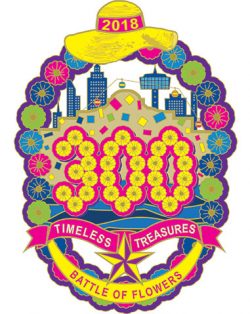
The theme of the 2018 Battle of Flowers Parade is “300 Timeless Treasures.” The parade will bring to life fond memories, magical moments, monumental milestones, and hopeful visions. This represents the heart and the spirit of our legendary city. The cry “Remember the Alamo” will also be accompanied by the cry “I Remember.”

 Happy Mother’s Day to all the moms out there. We honor you today, the second Sunday in May because of all you have done for us. Today I want to share a few tidbits of information about this 110-year-old holiday.
 organized boycotts of Mother’s Day, and threatened to issue lawsuits against the companies involved.
 onions, and gravy. She put the ingredients in a roasting pan and put it in the oven before we left for church.