Beating Death (Matthew 28)

05_Jesus_Resurrection_JPEG_1024Messiah is an English language oratorio composed in 1741 by George Frideric Handel. It contains  scriptural text compiled by Charles Jennens from the King James Bible. And from the version of the Psalms included with the Book of Common Prayer. It was first performed in Dublin on 13 April 1742 and received its London premiere nearly a year later. After an initially modest public reception, the oratorio gained in popularity. Eventually it became one of the best-known and most frequently performed choral works in Western music.

Messiah es un oratorio en inglés compuesto en 1741 por George Frideric Handel. Contiene texto bíblico compilado por Charles Jennens de la Biblia King James. Y de la versión de los Salmos incluidos con el Libro de Oración Común. Se realizó por primera vez en Dublín el 13 de abril de 1742 y recibió su estreno en Londres casi un año después. Después de una recepción pública inicialmente modesta, el oratorio ganó popularidad. Finalmente se convirtió en uno de los trabajos corales más conocidos y realizados con más frecuencia en la música occidental.

Source: Matthew 28  Mateo 28 (Español) 

Matthew 28

Jesus Has Risen

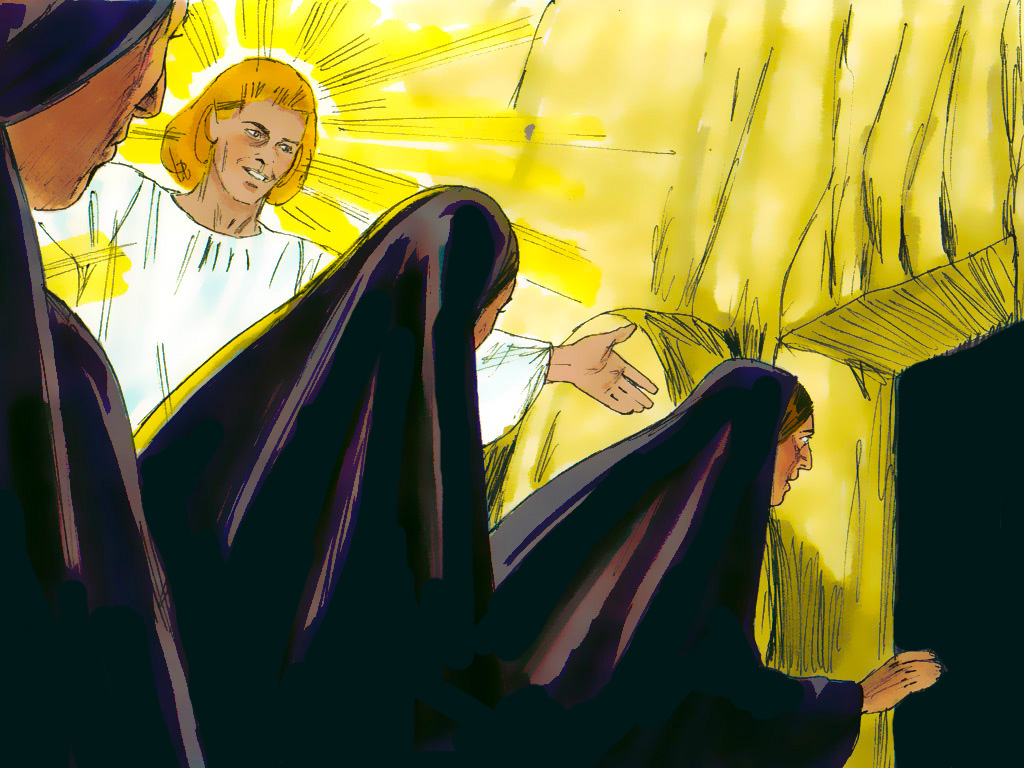
28 After the Sabbath, at dawn on the first day of the week, Mary Magdalene and the other Mary went to look at the tomb.

There was a violent earthquake, for an angel of the Lord came down from heaven and, going to the tomb, rolled back the stone and sat on it. His appearance was like lightning, and his clothes were white as snow. The guards were so afraid of him that they shook and became like dead men.

The angel said to the women, “Do not be afraid, for I know that you are looking for Jesus, who was crucified. He is not here; he has risen, just as he said. Come and see the place where he lay. Then go quickly and tell his disciples: ‘He has risen from the dead and is going ahead of you into Galilee. There you will see him.’ Now I have told you.”

So the women hurried away from the tomb, afraid yet filled with joy, and ran to tell his disciples. Suddenly Jesus met them. “Greetings,” he said. They came to him, clasped his feet and worshiped him. 10 Then Jesus said to them, “Do not be afraid. Go and tell my brothers to go to Galilee; there they will see me.”

The Guards’ Report

11 While the women were on their way, some of the guards went into the city and reported to the chief priests everything that had happened. 12 When the chief priests had met with the elders and devised a plan, they gave the soldiers a large sum of money, 13 telling them, “You are to say, ‘His disciples came during the night and stole him away while we were asleep.’ 14 If this report gets to the governor, we will satisfy him and keep you out of trouble.” 15 So the soldiers took the money and did as they were instructed. And this story has been widely circulated among the Jews to this very day.

The Great Commission

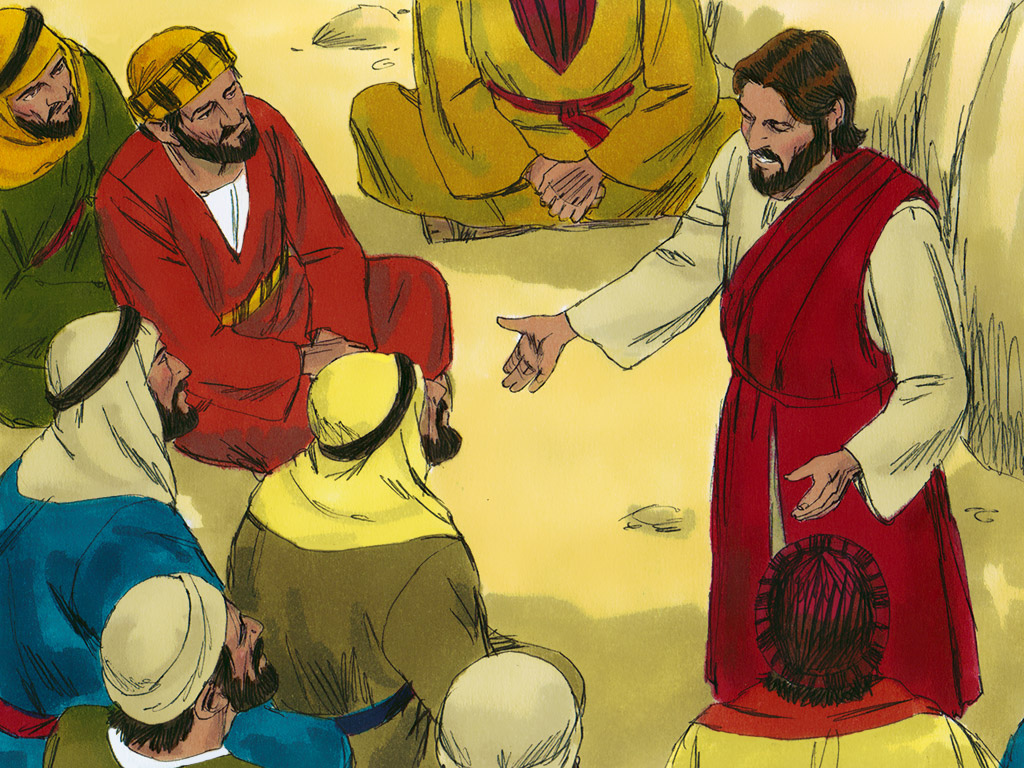
16 Then the eleven disciples went to Galilee, to the mountain where Jesus had told them to go. 17 When they saw him, they worshiped him; but some doubted.18 Then Jesus came to them and said, “All authority in heaven and on earth has been given to me. 19 Therefore go and make disciples of all nations, baptizing them in the name of the Father and of the Son and of the Holy Spirit, 20 and teaching them to obey everything I have commanded you. And surely I am with you always, to the very end of the age.”
Posted in Good Book | Comments Off on Beating Death (Matthew 28)

Every Scar Tells a Story (Mark 15)

07_Jesus_Crucified_Dies_1024_JPEGThe St Matthew Passion is a sacred oratorio written by Johann Sebastian Bach in 1727. It is written for solo voices, double choir and double orchestra. The oratorio sets chapters 26 and 27 of the Gospel of Matthew to music, with interspersed chorales and arias. It is widely regarded as one of the masterpieces of classical sacred music.

La Pasión de San Mateo es un oratorio sagrado escrito por Johann Sebastian Bach en 1727. Está escrito para voces solistas, coro doble y orquesta doble. El oratorio pone música a los capítulos 26 y 27 del Evangelio de Mateo, con corales intercalados y arias. Es ampliamente considerado como una de las obras maestras de la música sacra clásica.

Source: Mark 15  Marcos 15 (Español) 

Mark 15

Jesus Before Pilate

15 Very early in the morning, the chief priests, with the elders, the teachers of the law and the whole Sanhedrin, made their plans. So they bound Jesus, led him away and handed him over to Pilate.

“Are you the king of the Jews?” asked Pilate.

“You have said so,” Jesus replied.

The chief priests accused him of many things. So again Pilate asked him, “Aren’t you going to answer? See how many things they are accusing you of.”

But Jesus still made no reply, and Pilate was amazed.

Now it was the custom at the festival to release a prisoner whom the people requested. A man called Barabbas was in prison with the insurrectionists who had committed murder in the uprising. The crowd came up and asked Pilate to do for them what he usually did.

“Do you want me to release to you the king of the Jews?” asked Pilate,10 knowing it was out of self-interest that the chief priests had handed Jesus over to him. 11 But the chief priests stirred up the crowd to have Pilate release Barabbas instead.

12 “What shall I do, then, with the one you call the king of the Jews?” Pilate asked them.

13 “Crucify him!” they shouted.

14 “Why? What crime has he committed?” asked Pilate.

But they shouted all the louder, “Crucify him!”

15 Wanting to satisfy the crowd, Pilate released Barabbas to them. He had Jesus flogged, and handed him over to be crucified.

The Soldiers Mock Jesus

16 The soldiers led Jesus away into the palace (that is, the Praetorium) and called together the whole company of soldiers. 17 They put a purple robe on him, then twisted together a crown of thorns and set it on him. 18 And they began to call out to him, “Hail, king of the Jews!” 19 Again and again they struck him on the head with a staff and spit on him. Falling on their knees, they paid homage to him.20 And when they had mocked him, they took off the purple robe and put his own clothes on him. Then they led him out to crucify him.

The Crucifixion of Jesus

21 A certain man from Cyrene, Simon, the father of Alexander and Rufus, was passing by on his way in from the country, and they forced him to carry the cross.22 They brought Jesus to the place called Golgotha (which means “the place of the skull”). 23 Then they offered him wine mixed with myrrh, but he did not take it.24 And they crucified him. Dividing up his clothes, they cast lots to see what each would get.

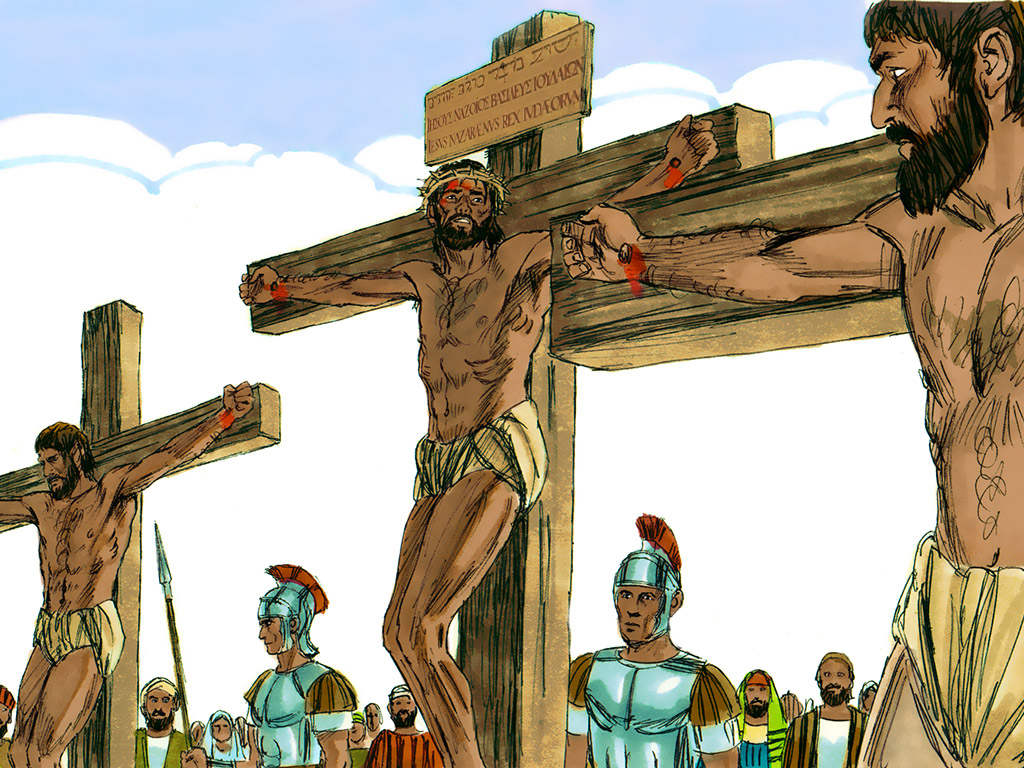
25 It was nine in the morning when they crucified him. 26 The written notice of the charge against him read: the king of the jews.

27 They crucified two rebels with him, one on his right and one on his left. [28] [a]29 Those who passed by hurled insults at him, shaking their heads and saying, “So! You who are going to destroy the temple and build it in three days, 30 come down from the cross and save yourself!” 31 In the same way the chief priests and the teachers of the law mocked him among themselves. “He saved others,” they said, “but he can’t save himself! 32 Let this Messiah, this king of Israel, come down now from the cross, that we may see and believe.” Those crucified with him also heaped insults on him.

The Death of Jesus

33 At noon, darkness came over the whole land until three in the afternoon. 34 And at three in the afternoon Jesus cried out in a loud voice, “Eloi, Eloi, lema sabachthani?” (which means “My God, my God, why have you forsaken me?”).[b]

35 When some of those standing near heard this, they said, “Listen, he’s calling Elijah.”

36 Someone ran, filled a sponge with wine vinegar, put it on a staff, and offered it to Jesus to drink. “Now leave him alone. Let’s see if Elijah comes to take him down,” he said.

37 With a loud cry, Jesus breathed his last.

38 The curtain of the temple was torn in two from top to bottom. 39 And when the centurion, who stood there in front of Jesus, saw how he died,[c] he said, “Surely this man was the Son of God!”

40 Some women were watching from a distance. Among them were Mary Magdalene, Mary the mother of James the younger and of Joseph,[d] and Salome.41 In Galilee these women had followed him and cared for his needs. Many other women who had come up with him to Jerusalem were also there.

The Burial of Jesus

42 It was Preparation Day (that is, the day before the Sabbath). So as evening approached, 43 Joseph of Arimathea, a prominent member of the Council, who was himself waiting for the kingdom of God, went boldly to Pilate and asked for Jesus’ body. 44 Pilate was surprised to hear that he was already dead. Summoning the centurion, he asked him if Jesus had already died. 45 When he learned from the centurion that it was so, he gave the body to Joseph. 46 So Joseph bought some linen cloth, took down the body, wrapped it in the linen, and placed it in a tomb cut out of rock. Then he rolled a stone against the entrance of the tomb.47 Mary Magdalene and Mary the mother of Joseph saw where he was laid.

Posted in Good Book | Comments Off on Every Scar Tells a Story (Mark 15)

God Is Looking for What He Loves (Luke 15)

06_Parables_Kingdom_Heaven_1024The theme music for four Olympic games was composed by John Towner Williams (born February 8, 1932), an American composer, conductor, and pianist. In a career spanning over six decades, Williams has composed some of the most popular and recognizable film scores in cinematic history.

El tema musical de cuatro juegos olímpicos fue compuesta por John Towner Williams (nacido el 08 de febrero 1932 ) , un estadounidense compositor , director de orquesta y pianista. En una carrera que abarca más de seis décadas , Williams ha compuesto algunas de las bandas sonoras más populares y reconocibles en la historia del cine.

Source: Luke 15 Lucas 15(Español)  

Luke 15

The Parable of the Lost Sheep

15 Now the tax collectors and sinners were all gathering around to hear Jesus. But the Pharisees and the teachers of the law muttered, “This man welcomes sinners and eats with them.”

Then Jesus told them this parable: “Suppose one of you has a hundred sheep and loses one of them. Doesn’t he leave the ninety-nine in the open country and go after the lost sheep until he finds it? And when he finds it, he joyfully puts it on his shoulders and goes home. Then he calls his friends and neighbors together and says, ‘Rejoice with me; I have found my lost sheep.’ I tell you that in the same way there will be more rejoicing in heaven over one sinner who repents than over ninety-nine righteous persons who do not need to repent.

The Parable of the Lost Coin

“Or suppose a woman has ten silver coins[a] and loses one. Doesn’t she light a lamp, sweep the house and search carefully until she finds it? And when she finds it, she calls her friends and neighbors together and says, ‘Rejoice with me; I have found my lost coin.’ 10 In the same way, I tell you, there is rejoicing in the presence of the angels of God over one sinner who repents.”

The Parable of the Lost Son

11 Jesus continued: “There was a man who had two sons. 12 The younger one said to his father, ‘Father, give me my share of the estate.’ So he divided his property between them.

13 “Not long after that, the younger son got together all he had, set off for a distant country and there squandered his wealth in wild living. 14 After he had spent everything, there was a severe famine in that whole country, and he began to be in need. 15 So he went and hired himself out to a citizen of that country, who sent him to his fields to feed pigs. 16 He longed to fill his stomach with the pods that the pigs were eating, but no one gave him anything.

17 “When he came to his senses, he said, ‘How many of my father’s hired servants have food to spare, and here I am starving to death! 18 I will set out and go back to my father and say to him: Father, I have sinned against heaven and against you. 19 I am no longer worthy to be called your son; make me like one of your hired servants.’20 So he got up and went to his father.

“But while he was still a long way off, his father saw him and was filled with compassion for him; he ran to his son, threw his arms around him and kissed him.

21 “The son said to him, ‘Father, I have sinned against heaven and against you. I am no longer worthy to be called your son.’

22 “But the father said to his servants, ‘Quick! Bring the best robe and put it on him. Put a ring on his finger and sandals on his feet. 23 Bring the fattened calf and kill it. Let’s have a feast and celebrate. 24 For this son of mine was dead and is alive again; he was lost and is found.’ So they began to celebrate.

25 “Meanwhile, the older son was in the field. When he came near the house, he heard music and dancing. 26 So he called one of the servants and asked him what was going on. 27 ‘Your brother has come,’ he replied, ‘and your father has killed the fattened calf because he has him back safe and sound.’

28 “The older brother became angry and refused to go in. So his father went out and pleaded with him. 29 But he answered his father, ‘Look! All these years I’ve been slaving for you and never disobeyed your orders. Yet you never gave me even a young goat so I could celebrate with my friends. 30 But when this son of yours who has squandered your property with prostitutes comes home, you kill the fattened calf for him!’

31 “‘My son,’ the father said, ‘you are always with me, and everything I have is yours. 32 But we had to celebrate and be glad, because this brother of yours was dead and is alive again; he was lost and is found.’”

Posted in Good Book | 3 Comments