During the fourth century the practice of bringing evergreen trees indoors during the dark days of winter spread across Europe. In medieval Germany, the increase in Christianity gave rise to a new tradition. Germans began decorating the trees with apples to represent the garden of Eden. “Paradise trees” were soon decorated with additional food items like nuts and sugar wafers. As Germans immigrated to other parts of the world they took their Christmas tree tradition with them. in 1848 Queen Victoria encouraged her German husband, prince Albert to decorate a tree like those he had in his childhood. This Victorian tree, decorated with sweets, ornaments and candles was featured in the Illustrated London News. Suddenly, people in England and the United States created increasingly elaborate trees in an attempt to outdo one another. German artisans began crafting delicate glass ornaments and in 1882 Edward Johnson, an associate of Thomas Edison created the first strand of Christmas tree lights. This year over 100 million Christmas trees will be on display worldwide. For more details see History of Christmas Trees – Christmas – HISTORY.com.
The music for O Tannenbaum is from a 16th century German folk song. There are multiple versions of lyrics with this tune and rather then select one I thought I would just play a very familiar instrumental version today. Now when you hear this song, or see a Christmas tree think of the Germans and Queen Victoria, and thank them for this centerpiece of our Christmas traditions.
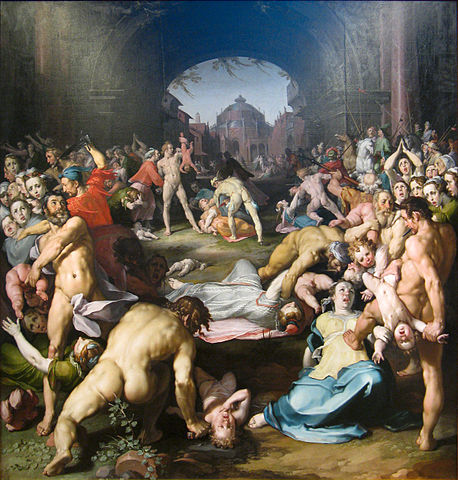
There are others in the Christmas story that are often overlooked; the mothers and their innocent children massacred by the order of King Herod.
Matthew 2:13-18
13 When they had gone, an angel of the Lord appeared to Joseph in a dream. “Get up,” he said, “take the child and his mother and escape to Egypt. Stay there until I tell you, for Herod is going to search for the child to kill him.”
14 So he got up, took the child and his mother during the night and left for Egypt, 15 where he stayed until the death of Herod. And so was fulfilled what the Lord had said through the prophet: “Out of Egypt I called my son”.
16 When Herod realized that he had been outwitted by the Magi, he was furious, and he gave orders to kill all the boys in Bethlehem and its vicinity who were two years old and under, in accordance with the time he had learned from the Magi. 17 Then what was said through the prophet Jeremiah was fulfilled:
18 “A voice is heard in Ramah,
weeping and great mourning,
Rachel weeping for her children
and refusing to be comforted,
because they are no more.”
The “Coventry Carol” is an English Christmas carol dating from the 16th century. The carol was traditionally performed in Coventry in England as part of a mystery play called The Pageant of the Shearmen and Tailors. The play depicts the Christmas story from chapter two in the Gospel of Matthew: the carol itself refers to the Massacre of the Innocents, in which Herod ordered all male infants under the age of two in Bethlehem to be killed, and takes the form of a lullaby sung by mothers of the doomed children. For more information see: Coventry Carol – Wikipedia, the free encyclopedia.
Lully, lullay, Thou little tiny Child,
Bye, bye, lully, lullay.
Lullay, thou little tiny Child,
Bye, bye, lully, lullay.
That woe is me, poor Child for Thee!
And ever mourn and sigh,
For thy parting neither say nor sing,
Bye, bye, lully, lullay.
Next time: O Tannenbaum
Share List
Posted inGeneral|Comments Off on The Dark Side of Christmas
We continue our discussion of the supporting actors in the Christmas story with Luke 2:8–18.
The shepherds
8 And there were shepherds living out in the fields nearby, keeping watch over their flocks at night. 9 An angel of the Lord appeared to them, and the glory of the Lord shone around them, and they were terrified. 10 But the angel said to them, “Do not be afraid. I bring you good news that will cause great joy for all the people. 11 Today in the town of David a Savior has been born to you; he is the Messiah, the Lord. 12 This will be a sign to you: You will find a baby wrapped in cloths and lying in a manger.”
13 Suddenly a great company of the heavenly host appeared with the angel, praising God and saying,
14 “Glory to God in the highest heaven,
and on earth peace to those on whom his favor rests.”
15 When the angels had left them and gone into heaven, the shepherds said to one another, “Let’s go to Bethlehem and see this thing that has happened, which the Lord has told us about.”
16 So they hurried off and found Mary and Joseph, and the baby, who was lying in the manger. 17 When they had seen him, they spread the word concerning what had been told them about this child, 18 and all who heard it were amazed at what the shepherds said to them.
“While Shepherds Watched Their Flocks” is a Christmas carol describing the Annunciation to the Shepherds, with words attributed to Irish hymnist, lyricist and England’s Poet Laureate, Nahum Tate.
The exact date of Tate’s composition is not known, but the words appeared in Tate and Nicholas Brady’s 1700 supplement to their New Version of the Psalms of David of 1696. It was the only Christmas hymn authorised to be sung by the Anglican Church; before 1700 only the Psalms of David were permitted to be sung. (wikipedia)
The Magi
Matthew 2:1-12
After Jesus was born in Bethlehem in Judea, during the time of King Herod, Magi from the east came to Jerusalem 2 and asked, “Where is the one who has been born king of the Jews? We saw his star when it rose and have come to worship him.”
3 When King Herod heard this he was disturbed, and all Jerusalem with him. 4 When he had called together all the people’s chief priests and teachers of the law, he asked them where the Messiah was to be born. 5 “In Bethlehem in Judea,” they replied, “for this is what the prophet has written:
6 “‘But you, Bethlehem, in the land of Judah,
are by no means least among the rulers of Judah;
for out of you will come a ruler
who will shepherd my people Israel.”
7 Then Herod called the Magi secretly and found out from them the exact time the star had appeared. 8 He sent them to Bethlehem and said, “Go and search carefully for the child. As soon as you find him, report to me, so that I too may go and worship him.”
9 After they had heard the king, they went on their way, and the star they had seen when it rose went ahead of them until it stopped over the place where the child was. 10 When they saw the star, they were overjoyed. 11 On coming to the house, they saw the child with his mother Mary, and they bowed down and worshiped him. Then they opened their treasures and presented him with gifts of gold, frankincense and myrrh. 12 And having been warned in a dream not to go back to Herod, they returned to their country by another route.
I’m not sure about the accuracy of this story but it is a bit of a fun read while you listen to seven instrumental versions of this classic carol.

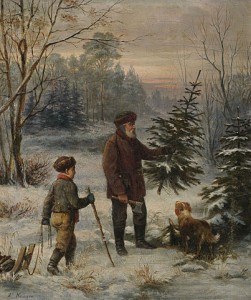 During the fourth century the practice of bringing evergreen trees indoors during the dark days of winter spread across Europe. In medieval Germany, the increase in Christianity gave rise to a new tradition. Germans began decorating the trees with apples to represent the garden of Eden. “Paradise trees” were soon decorated with additional food items like nuts and sugar wafers. As Germans immigrated to other parts of the world they took their Christmas tree tradition with them. in 1848 Queen Victoria encouraged her German husband, prince Albert to decorate a tree like those he had in his childhood. This Victorian tree, decorated with sweets, ornaments and candles was featured in the Illustrated London News. Suddenly, people in England and the United States created increasingly elaborate trees in an attempt to outdo one another. German artisans began crafting delicate glass ornaments and in 1882 Edward Johnson, an associate of Thomas Edison created the first strand of Christmas tree lights. This year over 100 million Christmas trees will be on display worldwide. For more details see History of Christmas Trees – Christmas – HISTORY.com.