Have you ever considered reading the Bible from start to finish but found the idea too intimidating? Some of you may have even purchased a “one year Bible” only to have it end up on a bookshelf. What if someone took the Bible’s 1,189 chapters and distilled them down to 100 daily readings? Better yet, how about receiving a link to those readings in your email so you could get to them from your computer, tablet or smart phone? Finally, if that’s not enough what if you could listen to a selection of classical music while reading each Scripture passage? If that sounds like the program for you please join me beginning June 1 for The Essential 100. Here is a sample of what you will see everyday.
Creation
Also sprach Zarathustra, Op. 30 (Thus Spoke Zarathustra or Thus Spake Zarathustra) is a tone poem by Richard Strauss, composed in 1896 and inspired by Friedrich Nietzsche’s philosophical novel of the same name. The composer conducted its first performance on 27 November 1896 in Frankfurt. A typical performance lasts half an hour.
“Sunrise” – the opening fanfare
The work has been part of the classical repertoire since its first performance in 1896. The initial fanfare – entitled “Sunrise” in the composer’s program notes – became particularly well-known after its use in Stanley Kubrick’s 1968 film 2001: A Space Odyssey.
1 In The Beginning God created the heavens and the earth.2 Now the earth was formless and empty, darkness was over the surface of the deep, and the Spirit of God was hovering over the waters.
3 And God said, “Let there be light,” and there was light.4 God saw that the light was good, and he separated the light from the darkness.5 God called the light “day,” and the darkness he called “night.” And there was evening, and there was morning—the first day.
6 And God said, “Let there be a vault between the waters to separate water from water.”7 So God made the vault and separated the water under the vault from the water above it. And it was so.8 God called the vault “sky.”And there was evening, and ……….. Continued on June 1.
Here are some things you can do right now:
Subscribe to be notified via email when new entries are posted.
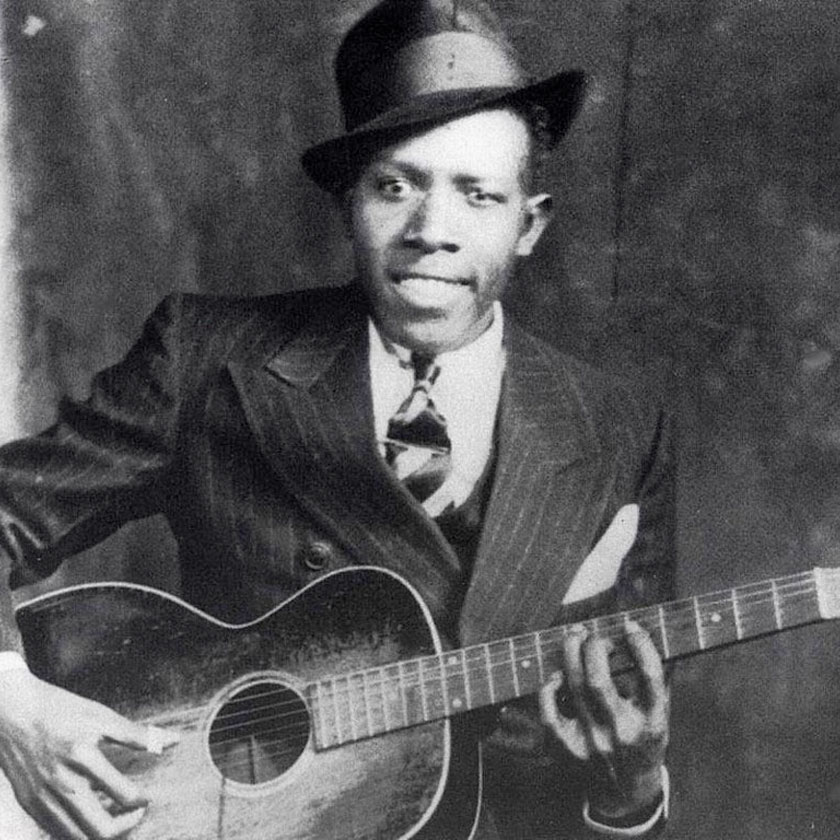
One hundred years ago, a boy-child was born in Mississippi – a dirt-poor, African-American who would grow up, learn to sing and play the blues, and eventually achieve worldwide renown. In the decades after his death, he has become known as the King of the Delta Blues Singers, his music expanding in influence to the point that rock stars of the greatest magnitude – the Rolling Stones, Bob Dylan, Eric Clapton, the Allman Brothers – all sing his praise and have recorded his songs.
That boy-child was Robert Johnson, an itinerant blues singer and guitarist who lived from 1911 to 1938. He recorded 29 songs between 1936 and ‘37 for the American Record Corporation, which released eleven 78rpm records on their Vocalion label during Johnson¹s lifetime, and one after his death.
Most of these tunes have attained canonical status, and are now considered enduring anthems of the genre: “Cross Road Blues,” “Love In Vain,” “Hellhound On My Trail,” “I Believe I¹ll Dust My Broom,” “Walking Blues,” “Sweet Home Chicago.”
Like many bluesmen of his day, Johnson plied his craft on street corners and in jook joints, ever rambling and ever lonely – and writing songs that romanticized that existence. But Johnson accomplished this with such an unprecedented intensity, marrying his starkly expressive vocals with a guitar mastery, that his music has endured long after the heyday of country blues and his own short life.
Never had the hardships of the world been transformed into such a poetic height; never had the blues plumbed such an emotional depth. Johnson took the intense loneliness, terrors and tortuous lifestyle that came with being an African-American in the South during the Great Depression, and transformed that specific and very personal experience into music of universal relevance and global reach. “You want to know how good the blues can get?” Keith Richards once asked, answering his own question: “Well, this is it.” Eric Clapton put it more plainly: “I have never found anything more deeply soulful than Robert Johnson.”
The power of Johnson’s music has been amplified over the years by the fact that so little about him is known and what little biographical information we now have only revealed itself at an almost glacial pace. Myths surrounding his life took over: that he was a country boy turned ladies’ man; that he only achieved his uncanny musical mastery after selling his soul to the devil. Even the tragedy of his death seemed to grow to mythic proportion: being poisoned by a jealous boyfriend then taking three days to expire, even as the legendary talent scout John Hammond was searching him out to perform at Carnegie Hall in New York City.
In 1990, Sony Legacy produced and released the 2-CD box set Robert Johnson: The Complete Recordings to widespread critical acclaim and, for a country blues reissue, unprecedented sales. The Complete Recordings proved the existence of a potential market for music from the deepest reaches of Sony¹s catalog, especially if buoyed by a strong story with mainstream appeal. Johnson¹s legend continues to attract an ever-widening audience, with no sign of abating. If, in today¹s world of hip-hop and heavy metal, a person knows of only one country blues artist, odds are it is Robert Johnson.
Many of the artists who claim to have been influenced by Johnson the most, injecting his revolutionary stylings into their work and recording tribute songs and collections, are prominent rock musicians from the United Kingdom. His impact and influence on these future star musicians from England—who would then come to develop and define both the rock and roll and rock music eras—resulted not from personal appearances or direct fraternization. Instead, the artistic power of his exceptional talents and original compositions would be relayed across the Atlantic many years after his death through the compilation of his works released in 1961 by Columbia Records (King of the Delta Blues Singers).
Brian Jones of the Rolling Stones introduced bandmate Keith Richards to his first Robert Johnson album. The blues master’s recordings would have as much impact on him as on Mick Jagger. The group performed his “Walkin’ Blues” at the Rock and Roll Circus in 1968. They arranged their own version of “Love in Vain” for their album Let It Bleed and recorded “Stop Breakin’ Down Blues” for Exile on Main Street.
Stop Breaking Down by the Rolling Stones
In addition, Mick Jagger, in his role as Turner in the 1970 film Performance, performs solo excerpts from “Come On In My Kitchen” and “Me and the Devil Blues.”
Alexis Korner, referred to as “the Founding Father of British Blues”, co-wrote and recorded a song entitled “Robert Johnson” on his The Party Album released in 1978. Other examples of the influence he had on English blues and blues-rock musicians and musical groups include:
Christmas Eve 1818. In 1818 the carol “Stille Nacht! Heilige Nacht” was heard for the first time in a village church in Oberndorf, Austria. The congregation at that Midnight Mass in St. Nicholas Church listened as the voices of the assistant pastor, Father Joseph Mohr, and the choir director, Franz Xaver Gruber, rang through the church to the accompaniment of Father Mohr’s guitar. On each of the six verses, the choir repeated the last two lines in four-part harmony. On that Christmas Eve, a song was born that would wing its way into the hearts of people throughout the world. Now translated into hundreds of languages, it is sung by untold millions every December from small chapels in the Andes to great cathedrals in Antwerp and Rome.
Though meant for a performance in a church Silent Night was composed for guitar. That is rather unusual for those days. Joseph Mohr’s guitar still can be seen at Hallein’s Franz Gruber Museum
Some fanciful tales. Today books, films and Internet sites are filled with fanciful tales purporting to tell the history of “Silent Night.” Some tell of mice eating the bellows of the organ creating the necessity for a hymn to be accompanied by a guitar. Others claim that Joseph Mohr was forced to write the words to a new carol in haste since the organ would not play. A recent film, created for Austrian television places Oberndorf in the Alps and includes evil railroad barons and a double-dealing priest, while a recent book by a German author places a zither in the hands of Franz Gruber and connects Joseph Mohr with a tragic fire engulfing the city of Salzburg. You can read claims that “Silent Night” was sung on Christmas Eve in 1818 and then forgotten by its creators. Of course, the latter are easily discounted by manuscript arrangements of the carol by both Mohr and Gruber which were produced at various times between 1820 and 1855. In this age of tabloid journalism, it’s not surprising that some feel it necessary to invent frivolous anecdotes and create fables for a story that is quite beautiful in its simplicity.
Father Joseph Mohr. A young priest in Mariapfarr. The German words for the original six stanzas of the carol we know as “Silent Night” were written by Joseph Mohr in 1816, when he was a young priest assigned to a pilgrimage church in Mariapfarr, Austria. His grandfather lived nearby, and it is easy to imagine that he could have come up with the words while walking through the countryside on a visit to his elderly relative. The fact is, we have no idea if any particular event inspired Joseph Mohr to pen his poetic version of the birth of the Christ child. The world is fortunate, however, that he didn’t leave it behind when he was transferred to Oberndorf the following year (1817).
Franz Gruber. On December 24, 1818 Joseph Mohr journeyed to the home of musician-schoolteacher Franz Gruber who lived in an apartment over the schoolhouse in nearby Arnsdorf. He showed his friend the poem and asked him to add a melody and guitar accompaniment so that it could be sung at Midnight Mass. His reason for wanting the new carol is unknown. Some speculate that the organ would not work; others feel that the assistant pastor, who dearly loved guitar music, merely wanted a new carol for Christmas.
This will be my final post on the topic of Christmas music. After a couple of weeks off I’ll be back to begin a new topic. Please vote for the topic you’d most like to hear more about. I wish all of you a very Merry Christmas and a happy new year.

 Have you ever considered reading the Bible from start to finish but found the idea too intimidating? Some of you may have even purchased a “one year Bible” only to have it end up on a bookshelf. What if someone took the Bible’s 1,189 chapters and distilled them down to 100 daily readings? Better yet, how about receiving a link to those readings in your email so you could get to them from your computer, tablet or smart phone? Finally, if that’s not enough what if you could listen to a selection of classical music while reading each Scripture passage? If that sounds like the program for you please join me beginning June 1 for The Essential 100. Here is a sample of what you will see everyday.
 Also sprach Zarathustra, Op. 30 (Thus Spoke Zarathustra or Thus Spake Zarathustra) is a tone poem by Richard Strauss, composed in 1896 and inspired by Friedrich Nietzsche’s philosophical novel of the same name. The composer conducted its first performance on 27 November 1896 in Frankfurt. A typical performance lasts half an hour.