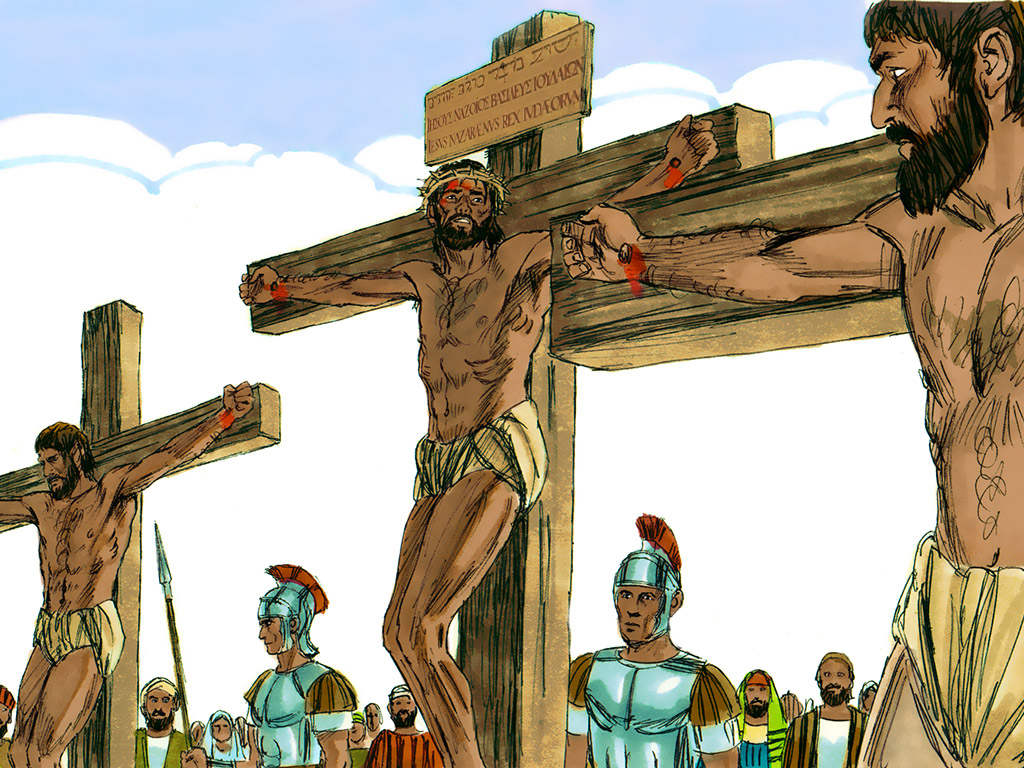
John 19:1-42 – The Crucifixion

07_Jesus_Crucified_Dies_1024_JPEGThe St Matthew Passion is a sacred oratorio written by Johann Sebastian Bach in 1727 for solo voices, double choir and double orchestra. It sets chapters 26 and 27 of the Gospel of Matthew to music, with interspersed chorales and arias. It is widely regarded as one of the masterpieces of classical sacred music.

La Pasión según San Mateo es un oratorio sagrado escrito por Johann Sebastian Bach en 1727 para voces solistas , coro doble y doble orquesta. En él se establecen los capítulos 26 y 27 del Evangelio de Mateo a la música , con corales intercalados y arias . Es ampliamente considerado como una de las obras maestras de la música sagrada clásica.

La Passione di San Matteo è una composizione di musica sacra scritta da Johann Sebastian Bach nel 1727 per voci soliste , doppio coro e doppia orchestra . Esso stabilisce i capitoli 26 e 27 del Vangelo di Matteo alla musica , con corali intervallati e arie . E ‘ considerato uno dei capolavori della musica sacra classica .

Source: John 19:1-42  Juan 19(Español)  Giovanni 19(Italiano)

John 19

Jesus Sentenced to Be Crucified

19 Then Pilate took Jesus and had him flogged. The soldiers twisted together a crown of thorns and put it on his head. They clothed him in a purple robe and went up to him again and again, saying, “Hail, king of the Jews!” And they slapped him in the face.

Once more Pilate came out and said to the Jews gathered there, “Look, I am bringing him out to you to let you know that I find no basis for a charge against him.” When Jesus came out wearing the crown of thorns and the purple robe, Pilate said to them, “Here is the man!”

As soon as the chief priests and their officials saw him, they shouted, “Crucify! Crucify!”

But Pilate answered, “You take him and crucify him. As for me, I find no basis for a charge against him.”

The Jewish leaders insisted, “We have a law, and according to that law he must die,because he claimed to be the Son of God.”

When Pilate heard this, he was even more afraid, and he went back inside the palace.“Where do you come from?” he asked Jesus, but Jesus gave him no answer. 10 “Do you refuse to speak to me?” Pilate said. “Don’t you realize I have power either to free you or to crucify you?”

11 Jesus answered, “You would have no power over me if it were not given to you from above. Therefore the one who handed me over to you is guilty of a greater sin.”

12 From then on, Pilate tried to set Jesus free, but the Jewish leaders kept shouting, “If you let this man go, you are no friend of Caesar. Anyone who claims to be a king opposes Caesar.”

13 When Pilate heard this, he brought Jesus out and sat down on the judge’s seat at a place known as the Stone Pavement (which in Aramaic is Gabbatha). 14 It was the day of Preparation of the Passover; it was about noon.

“Here is your king,” Pilate said to the Jews.

15 But they shouted, “Take him away! Take him away! Crucify him!”

“Shall I crucify your king?” Pilate asked.

“We have no king but Caesar,” the chief priests answered.

16 Finally Pilate handed him over to them to be crucified.

The Crucifixion of Jesus

So the soldiers took charge of Jesus. 17 Carrying his own cross, he went out to the place of the Skull (which in Aramaic is called Golgotha). 18 There they crucified him, and with him two others—one on each side and Jesus in the middle.

19 Pilate had a notice prepared and fastened to the cross. It read: jesus of nazareththe king of the jews. 20 Many of the Jews read this sign, for the place where Jesus was crucified was near the city, and the sign was written in Aramaic, Latin and Greek. 21 The chief priests of the Jews protested to Pilate, “Do not write ‘The King of the Jews,’ but that this man claimed to be king of the Jews.”

22 Pilate answered, “What I have written, I have written.”

23 When the soldiers crucified Jesus, they took his clothes, dividing them into four shares, one for each of them, with the undergarment remaining. This garment was seamless, woven in one piece from top to bottom.

24 “Let’s not tear it,” they said to one another. “Let’s decide by lot who will get it.”

This happened that the scripture might be fulfilled that said,

“They divided my clothes among them
    and cast lots for my garment.”[a]

So this is what the soldiers did.

25 Near the cross of Jesus stood his mother, his mother’s sister, Mary the wife of Clopas, and Mary Magdalene. 26 When Jesus saw his mother there, and the disciple whom he loved standing nearby, he said to her, “Woman,[b] here is your son,” 27 and to the disciple, “Here is your mother.” From that time on, this disciple took her into his home.

The Death of Jesus

28 Later, knowing that everything had now been finished, and so that Scripture would be fulfilled, Jesus said, “I am thirsty.” 29 A jar of wine vinegar was there, so they soaked a sponge in it, put the sponge on a stalk of the hyssop plant, and lifted it to Jesus’ lips.30 When he had received the drink, Jesus said, “It is finished.” With that, he bowed his head and gave up his spirit.

31 Now it was the day of Preparation, and the next day was to be a special Sabbath. Because the Jewish leaders did not want the bodies left on the crosses during the Sabbath, they asked Pilate to have the legs broken and the bodies taken down. 32 The soldiers therefore came and broke the legs of the first man who had been crucified with Jesus, and then those of the other. 33 But when they came to Jesus and found that he was already dead, they did not break his legs. 34 Instead, one of the soldiers pierced Jesus’ side with a spear, bringing a sudden flow of blood and water. 35 The man who saw it has given testimony, and his testimony is true. He knows that he tells the truth, and he testifies so that you also may believe. 36 These things happened so that the scripture would be fulfilled: “Not one of his bones will be broken,”[c] 37 and, as another scripture says, “They will look on the one they have pierced.”[d]

The Burial of Jesus

38 Later, Joseph of Arimathea asked Pilate for the body of Jesus. Now Joseph was a disciple of Jesus, but secretly because he feared the Jewish leaders. With Pilate’s permission, he came and took the body away. 39 He was accompanied by Nicodemus, the man who earlier had visited Jesus at night. Nicodemus brought a mixture of myrrh and aloes, about seventy-five pounds.[e] 40 Taking Jesus’ body, the two of them wrapped it, with the spices, in strips of linen. This was in accordance with Jewish burial customs. 41 At the place where Jesus was crucified, there was a garden, and in the garden a new tomb, in which no one had ever been laid. 42 Because it was the Jewish day of Preparation and since the tomb was nearby, they laid Jesus there.
Posted in Essential 100 | 2 Comments

John 18:1-40 – Arrest and Trial 

04_Gethsemane_Peter_JPEGThe Lagrime di San Pietro (Saint Peter’s Tears) is a cycle of 20 madrigals and a concluding motet by the late Renaissance composer Orlande de Lassus. The Lagrime sets 20 poems by the Italian poet Luigi Tansillo (1510–1568) depicting the stages of grief experienced by St. Peter after his denial of Christ, and his memory of Christ’s admonition.

El Lagrime di San Pietro (Las lágrimas de San Pedro ) es un ciclo de 20 madrigales y un motete de clausura por el fallecido compositor renacentista Orlando di Lasso . El Lagrime establece 20 poemas del poeta italiano Luigi Tansillo ( 1510-1568 ) que representa las etapas del dolor experimentado por San Pedro después de su negación de Cristo , y su recuerdo de la amonestación de Cristo.

Il Lagrime di San Pietro ( Lacrime di San Pietro ) è un ciclo di 20 madrigali e un mottetto conclusiva del compianto compositore rinascimentale Orlando di Lasso . Il Lagrime imposta 20 poesie del poeta italiano Luigi Tansillo ( 1510-1568 ) raffiguranti le fasi del dolore vissuto da san Pietro dopo il rinnegamento di Cristo , e la sua memoria di ammonimento di Cristo.

Source: John 18:1-40  Juan 18(Español)  Giovanni 18 (Italiano)

John 18

Jesus Arrested

18 When he had finished praying, Jesus left with his disciples and crossed the Kidron Valley. On the other side there was a garden, and he and his disciples went into it.

Now Judas, who betrayed him, knew the place, because Jesus had often met there with his disciples. So Judas came to the garden, guiding a detachment of soldiers and some officials from the chief priests and the Pharisees. They were carrying torches, lanterns and weapons.

Jesus, knowing all that was going to happen to him, went out and asked them, “Who is it you want?”

“Jesus of Nazareth,” they replied.

“I am he,” Jesus said. (And Judas the traitor was standing there with them.) When Jesus said, “I am he,” they drew back and fell to the ground.

Again he asked them, “Who is it you want?”

“Jesus of Nazareth,” they said.

Jesus answered, “I told you that I am he. If you are looking for me, then let these men go.” This happened so that the words he had spoken would be fulfilled: “I have not lost one of those you gave me.”[a]

10 Then Simon Peter, who had a sword, drew it and struck the high priest’s servant, cutting off his right ear. (The servant’s name was Malchus.)

11 Jesus commanded Peter, “Put your sword away! Shall I not drink the cup the Father has given me?”

12 Then the detachment of soldiers with its commander and the Jewish officials arrested Jesus. They bound him13 and brought him first to Annas, who was the father-in-law of Caiaphas, the high priest that year. 14 Caiaphas was the one who had advised the Jewish leaders that it would be good if one man died for the people.

Peter’s First Denial

15 Simon Peter and another disciple were following Jesus. Because this disciple was known to the high priest, he went with Jesus into the high priest’s courtyard, 16 but Peter had to wait outside at the door. The other disciple, who was known to the high priest, came back, spoke to the servant girl on duty there and brought Peter in.

17 “You aren’t one of this man’s disciples too, are you?” she asked Peter.

He replied, “I am not.”

18 It was cold, and the servants and officials stood around a fire they had made to keep warm. Peter also was standing with them, warming himself.

The High Priest Questions Jesus

19 Meanwhile, the high priest questioned Jesus about his disciples and his teaching.

20 “I have spoken openly to the world,” Jesus replied. “I always taught in synagogues or at the temple, where all the Jews come together. I said nothing in secret. 21 Why question me? Ask those who heard me. Surely they know what I said.”

22 When Jesus said this, one of the officials nearby slapped him in the face. “Is this the way you answer the high priest?” he demanded.

23 “If I said something wrong,” Jesus replied, “testify as to what is wrong. But if I spoke the truth, why did you strike me?” 24 Then Annas sent him bound to Caiaphas the high priest.

Peter’s Second and Third Denials

25 Meanwhile, Simon Peter was still standing there warming himself. So they asked him, “You aren’t one of his disciples too, are you?”

He denied it, saying, “I am not.”

26 One of the high priest’s servants, a relative of the man whose ear Peter had cut off, challenged him, “Didn’t I see you with him in the garden?” 27 Again Peter denied it, and at that moment a rooster began to crow.

Jesus Before Pilate

28 Then the Jewish leaders took Jesus from Caiaphas to the palace of the Roman governor. By now it was early morning, and to avoid ceremonial uncleanness they did not enter the palace, because they wanted to be able to eat the Passover. 29 So Pilate came out to them and asked, “What charges are you bringing against this man?”

30 “If he were not a criminal,” they replied, “we would not have handed him over to you.”

31 Pilate said, “Take him yourselves and judge him by your own law.”

“But we have no right to execute anyone,” they objected. 32 This took place to fulfill what Jesus had said about the kind of death he was going to die.

33 Pilate then went back inside the palace, summoned Jesus and asked him, “Are you the king of the Jews?”

34 “Is that your own idea,” Jesus asked, “or did others talk to you about me?”

35 “Am I a Jew?” Pilate replied. “Your own people and chief priests handed you over to me. What is it you have done?”

36 Jesus said, “My kingdom is not of this world. If it were, my servants would fight to prevent my arrest by the Jewish leaders. But now my kingdom is from another place.”

37 “You are a king, then!” said Pilate.

Jesus answered, “You say that I am a king. In fact, the reason I was born and came into the world is to testify to the truth. Everyone on the side of truth listens to me.”

38 “What is truth?” retorted Pilate. With this he went out again to the Jews gathered there and said, “I find no basis for a charge against him. 39 But it is your custom for me to release to you one prisoner at the time of the Passover. Do you want me to release ‘the king of the Jews’?”

40 They shouted back, “No, not him! Give us Barabbas!” Now Barabbas had taken part in an uprising.

Posted in Essential 100 | 1 Comment

Luke 22:1-46 – The Last Supper


08_Last_Supper_Jesus_JPEGHenry Purcell (September 1659 – 21 November 1695), was an English composer. Although incorporating Italian and French stylistic elements into his compositions, Purcell’s legacy was a uniquely English form of Baroque music. He is generally considered to be one of the greatest English composers; no other native-born English composer approached his fame until Edward Elgar.

Henry Purcell ( septiembre 1659 – 21 de noviembre 1695 ) , fue un compositor Inglés . Aunque la incorporación de elementos estilísticos italianos y franceses en sus composiciones , el legado de Purcell era una forma única Inglés de la música barroca . Él es generalmente considerado como uno de los más grandes compositores ingleses ; ningún otro compositor Inglés nativo se acercó a su fama hasta que Edward Elgar .

Henry Purcell ( settembre 1659 – 21 novembre 1695 ) , è stato un compositore inglese . Sebbene incorporando elementi stilistici italiani e francesi nelle sue composizioni , l’eredità di Purcell era una forma unica inglese della musica barocca . Egli è generalmente considerato uno dei più grandi compositori inglesi ; nessun altro nativo compositore inglese si avvicinò la sua fama fino Edward Elgar .

Source: Luke 22:1-46  Lucas 22:1-46(Español)  Luca 22:1-46(Italiano)   

Luke 22:1-46

Judas Agrees to Betray Jesus

22 Now the Festival of Unleavened Bread, called the Passover, was approaching, and the chief priests and the teachers of the law were looking for some way to get rid of Jesus, for they were afraid of the people. Then Satanentered Judas, called Iscariot, one of the Twelve. And Judas went to the chief priests and the officers of the temple guard and discussed with them how he might betray Jesus. They were delighted and agreed to give him money. He consented, and watched for an opportunity to hand Jesus over to them when no crowd was present.

The Last Supper

Then came the day of Unleavened Bread on which the Passover lamb had to be sacrificed. Jesus sent Peter and John, saying, “Go and make preparations for us to eat the Passover.”

“Where do you want us to prepare for it?” they asked.

10 He replied, “As you enter the city, a man carrying a jar of water will meet you. Follow him to the house that he enters, 11 and say to the owner of the house, ‘The Teacher asks: Where is the guest room, where I may eat the Passover with my disciples?’ 12 He will show you a large room upstairs, all furnished. Make preparations there.”

13 They left and found things just as Jesus had told them. So they prepared the Passover.

14 When the hour came, Jesus and his apostles reclined at the table. 15 And he said to them, “I have eagerly desired to eat this Passover with you before I suffer. 16 For I tell you, I will not eat it again until it finds fulfillment in the kingdom of God.”

17 After taking the cup, he gave thanks and said, “Take this and divide it among you. 18 For I tell you I will not drink again from the fruit of the vine until the kingdom of God comes.”

19 And he took bread, gave thanks and broke it, and gave it to them, saying, “This is my body given for you; do this in remembrance of me.”

20 In the same way, after the supper he took the cup, saying, “This cup is the new covenant in my blood, which is poured out for you.[a] 21 But the hand of him who is going to betray me is with mine on the table. 22 The Son of Man will go as it has been decreed. But woe to that man who betrays him!” 23 They began to question among themselves which of them it might be who would do this.

24 A dispute also arose among them as to which of them was considered to be greatest. 25 Jesus said to them, “The kings of the Gentiles lord it over them; and those who exercise authority over them call themselves Benefactors. 26 But you are not to be like that. Instead, the greatest among you should be like the youngest, and the one who rules like the one who serves. 27 For who is greater, the one who is at the table or the one who serves? Is it not the one who is at the table? But I am among you as one who serves. 28 You are those who have stood by me in my trials. 29 And I confer on you a kingdom, just as my Father conferred one on me, 30 so that you may eat and drink at my table in my kingdom and sit on thrones, judging the twelve tribes of Israel.

31 “Simon, Simon, Satan has asked to sift all of you as wheat. 32 But I have prayed for you, Simon, that your faith may not fail. And when you have turned back, strengthen your brothers.”

33 But he replied, “Lord, I am ready to go with you to prison and to death.”

34 Jesus answered, “I tell you, Peter, before the rooster crows today, you will deny three times that you know me.”

35 Then Jesus asked them, “When I sent you without purse, bag or sandals, did you lack anything?”

“Nothing,” they answered.

36 He said to them, “But now if you have a purse, take it, and also a bag; and if you don’t have a sword, sell your cloak and buy one. 37 It is written: ‘And he was numbered with the transgressors’[b]; and I tell you that this must be fulfilled in me. Yes, what is written about me is reaching its fulfillment.”

38 The disciples said, “See, Lord, here are two swords.”

“That’s enough!” he replied.

Jesus Prays on the Mount of Olives

39 Jesus went out as usual to the Mount of Olives, and his disciples followed him. 40 On reaching the place, he said to them, “Pray that you will not fall into temptation.” 41 He withdrew about a stone’s throw beyond them, knelt down and prayed, 42 “Father, if you are willing, take this cup from me; yet not my will, but yours be done.”43 An angel from heaven appeared to him and strengthened him. 44 And being in anguish, he prayed more earnestly, and his sweat was like drops of blood falling to the ground.[c]

45 When he rose from prayer and went back to the disciples, he found them asleep, exhausted from sorrow.46 “Why are you sleeping?” he asked them. “Get up and pray so that you will not fall into temptation.”

Posted in Essential 100 | Comments Off on Luke 22:1-46 – The Last Supper